Back
Back
Arun - June 3, 2026
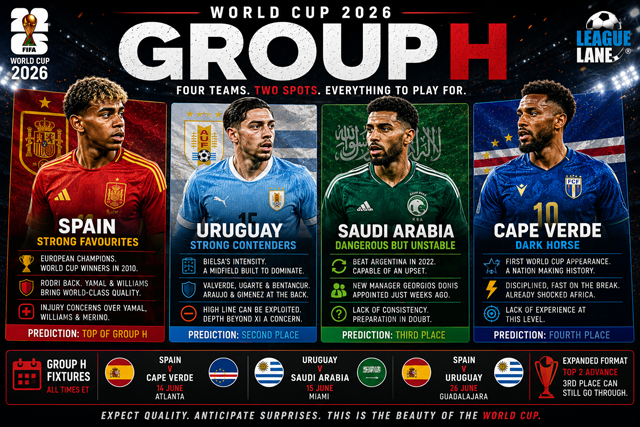
Group H is one of the most intriguing groups of the 2026 World Cup. Spain arrive as European champions and heavy favourites but the battle behind them is far from straightforward. Uruguay are genuine contenders under Marcelo Bielsa, not simply making up the numbers.
Saudi Arabia are inconsistent and have undergone a dramatic managerial change just weeks before the tournament. And Cape Verde, making their historic first World Cup appearance, are no pushover; a disciplined, dangerous side that has already stunned African football and could yet produce the surprise of the group stage.
Spain have the quality to win this group without breaking a sweat, but injury concerns around Lamine Yamal and Nico Williams add an element of uncertainty to their opener. Uruguay have Bielsa’s intensity, a world-class midfield and a genuine point to prove on the biggest stage.
Saudi Arabia, who famously beat Argentina in 2022, have sacked their manager less than six weeks before kickoff and replaced him with Georgios Donis, a decision that raises serious questions about their preparation. Cape Verde, making their debut after seven attempts to qualify, bring organisation, pace on the counter and the kind of hunger that debutants always carry into their first tournament.
For our full World Cup 2026 Group H preview and all related coverage, visit LeagueLane. For all our World Cup 2026 predictions and analysis visit LeagueLane.
Spain arrive in North America as European champions, World Cup winners in 2010, and one of the top favourites for the tournament. Luis de la Fuente has built a side with extraordinary depth, a Barcelona-dominated core, and a midfield that under Rodri is arguably the best in world football. This is a team that should top Group H and they know it.
The key talking point before a ball is kicked is fitness. Lamine Yamal is nursing a hamstring injury and while De la Fuente has stated he has “no doubt” his star man will be available for the opener against Cape Verde, the situation bears watching.
Nico Williams suffered a fresh hamstring setback in May and his availability for the early games is genuinely uncertain. Mikel Merino is also returning from injury. If all three are fit and firing, Spain are a different proposition entirely. If they are not, the first two games carry more risk than the odds suggest.
Rodri’s inclusion is the piece of good news that anchors everything else. The 2024 Ballon d’Or winner missed most of last season with a serious knee injury and is back. He is the spine around which Spain’s system is organised; without him they are a very good team, with him they are a great one. The notable absence is Dani Carvajal, whose fractured toe ended his World Cup before it started, while for the first time since 1950 there is no Real Madrid player in the squad.
Spain start their campaign on 15 June 2026 versus Cape Verde at Mercedes-Benz Stadium in Atlanta, then they take on Saudi Arabia on 21st at the same stadium before traveling to Guadalajara for the final group stage fixture against Uruguay.
Strengths: Rodri back and pulling the strings in midfield is a gamechanger for this squad; Yamal and Nico Williams give Spain an attacking width that no team in this group can match; extraordinary squad depth means rotation is possible without a drop in quality
Vulnerabilities: Yamal, Williams and Merino all managing fitness issues heading into the tournament; no natural right-back of Carvajal’s quality; the weight of expectation on a squad that won the Euros and will be expected to go deep here too
Prediction: Spain top Group H. Their quality is in a different bracket to everyone else in this group and De la Fuente has enough depth to manage injuries without losing control of results. The real test comes later in the tournament.
Uruguay are the group’s most interesting team from a tactical perspective. Marcelo Bielsa has been building something here with real intent and this squad, anchored by a world-class midfield trio and a formidable defensive partnership, is the most cohesive version of La Celeste in some time. Two-time world champions in 1930 and 1950, Uruguay arrive knowing they have the quality to cause Spain problems and the discipline to grind past Saudi Arabia and Cape Verde.
Federico Valverde is Uruguay’s engine; a Real Madrid midfielder who can carry the ball, press relentlessly, create chances and contribute defensively. Alongside him, Manuel Ugarte provides the destructive midfield presence at Manchester United and Rodrigo Bentancur brings composure and tempo from Tottenham. Ronald Araujo anchors the defence from Barcelona and Jose Maria Gimenez, approaching his 100th cap, leads from the back as captain. Darwin Nunez, now at Al-Hilal, leads the line with the same relentless running that made him such a threat at Liverpool.
The big story in the squad announcement is the omission of Luis Suarez. Bielsa has confirmed the decision was tactical rather than personal; Suarez, despite a resurgent spell at Inter Miami, was not recalled. Equally notable is the return of Fernando Muslera, the 39-year-old goalkeeper pulled out of international retirement for what will be a record fifth World Cup appearance for Uruguay. The June 26 clash with Spain in Guadalajara is the game that will define Uruguay’s tournament and tell us whether Bielsa has genuinely built something capable of competing at the highest level.
Prediction: Uruguay finish second in Group H. Bielsa’s side have the organisation and the individual quality to see off Saudi Arabia and Cape Verde and push Spain hard in the final group game. Six points from the first two games is the target.
Saudi Arabia come into this tournament carrying more uncertainty than any team in the group. In April 2026, just six weeks before their opening game, the Saudi Football Federation sacked Herve Renard following back-to-back friendly defeats. Six days later they appointed Georgios Donis, a 56-year-old Greek coach with experience in Saudi club football but no previous senior international management. The decision raises significant questions about preparation and cohesion heading into the biggest tournament in football.
The playing squad itself is not without quality. Seven of the starting eleven that produced one of the great World Cup upsets against Argentina in Qatar 2022 are still here, including captain Salem Al-Dawsari, who scored the winner that day and remains the heart of the side with 108 caps. Saud Abdulhamid has developed into one of the better right-backs in Asian football during his loan spell at Lens, Firas Al-Buraikan is a reliable finisher and Mohammed Al-Owais is an experienced goalkeeper. The continuity in the playing group is a strength; the instability on the touchline is a problem.
Saudi Arabia’s best World Cup performance remains their run to the Round of 16 in 1994 in the United States, so there is a symmetry to returning to American soil. They will need to beat Cape Verde in the final group game to have any real chance of progressing and even that cannot be taken for granted given the upheaval of recent months.
Prediction: Saudi Arabia’s group prospects hinge entirely on the Cape Verde game. They will not beat Spain or Uruguay but a win on June 26 could be enough to keep them alive in the hunt for a third-place qualifying spot depending on results elsewhere.
Cape Verde’s qualification for the 2026 World Cup is the greatest achievement in the history of Cape Verdean football. After seven attempts, Bubista’s side won their CAF qualifying group ahead of Cameroon, a result that shocked African football. With a population of around 525,000, they become one of the smallest nations ever to compete at a World Cup, and they arrive not as tourists but as a team with real defensive organisation and a clear tactical identity.
Bubista, full name Pedro Leitao Brito, has managed Cape Verde since 2020 and has built something coherent and competitive. The squad is drawn largely from the Cape Verdean diaspora in Europe; captain Ryan Mendes, the country’s all-time leading scorer and cap holder at 36, will lead the line in what is his first and almost certainly only World Cup. Logan Costa, a centre-back at Villarreal and the only Cape Verde player based in a top-five European league, is their standout individual and was only recently cleared to play having returned from ACL surgery in May. Goalkeeper Vozinha, at 39, is the oldest player in the squad and a vice-captain who has been central to this whole qualification story.
Cape Verde are not in this group to make up the numbers. They are a well-drilled side that is hard to break down, dangerous on the counter and entirely capable of causing Saudi Arabia serious problems on June 26. That game in Houston is effectively their final. If they manage their way through the Spain and Uruguay games without a catastrophic goal difference, they will arrive at matchday three with something to play for and the experience to handle it.
Prediction: Cape Verde will give Spain and Uruguay more to think about than most expect. The Saudi Arabia game is wide open and a Cape Verde win there is a genuine possibility. Do not dismiss them in the third-place qualification race.
15 June: Spain vs Cape Verde at Mercedes-Benz Stadium, Atlanta
Spain’s opener and Cape Verde’s first ever World Cup game. The occasion will be enormous for the Blue Sharks but they need to limit the damage here. A heavy defeat could end their third-place ambitions before they begin.
15 June: Saudi Arabia vs Uruguay at Hard Rock Stadium, Miami
The group’s opening night wildcard. Uruguay are favourites but Saudi Arabia under Donis are an unknown quantity. A Saudi upset here would blow the group wide open.
21 June: Spain vs Saudi Arabia at Mercedes-Benz Stadium, Atlanta
Spain should be comfortable but Saudi Arabia always carry the threat of the unexpected. The 2022 result against Argentina means nobody takes them lightly.
21 June: Uruguay vs Cape Verde at Hard Rock Stadium, Miami
Uruguay need to win this to keep control of second place. Cape Verde will make it difficult and the result will shape who arrives at matchday three with something to play for.
26 June: Cape Verde vs Saudi Arabia at NRG Stadium, Houston
The game that defines third place in this group. Both teams need a result. Saudi Arabia have the higher-ranked squad but Cape Verde have the organisation and hunger. This is a genuine final for two teams who could yet make history.
26 June at Uruguay vs Spain at Estadio Akron, Guadalajara
The standout fixture of Group H and potentially one of the matches of the group stage. If Uruguay have already secured second, Bielsa may set up to hurt Spain. If the group is still alive, expect 90 minutes of genuine intensity.
Spain top this group and that is the safest prediction available. Their quality is too far above the other three sides and De la Fuente has enough depth to manage the injury concerns around Yamal and Williams without panicking. The only real risk is a catastrophic injury to Rodri, and even then this squad has options.
Second place belongs to Uruguay if Bielsa gets his system working from the start. The midfield is outstanding, the defence is sound and Darwin Nunez will cause problems for any backline in this group. The Saudi opener on June 15 is the one that sets the tone; a Uruguay win there and this is done and dusted by matchday two.
Saudi Arabia’s tournament is defined by one decision taken in April. Replacing the manager six weeks before a World Cup is not a statement of ambition; it is a sign of panic. Donis has to organise a team in weeks that Renard was building for months. If they beat Cape Verde on June 26 they stay alive in the third-place conversation. If they do not, this will be a group stage exit that raises hard questions about the direction of Saudi football.
Cape Verde are the story of the group. This is a nation of 525,000 people at their first World Cup, managed by a former player who has built something real and disciplined. They will not win Group H. They may not make it through as a third-place qualifier. But they will not embarrass themselves and the Saudi Arabia game on June 26 is one of the matches of the group stage with a genuine result available for either team. For a betting angle, Cape Verde to beat Saudi Arabia and Uruguay to win the group represents the best value in Group H.