Back
Back
Arun - June 4, 2026
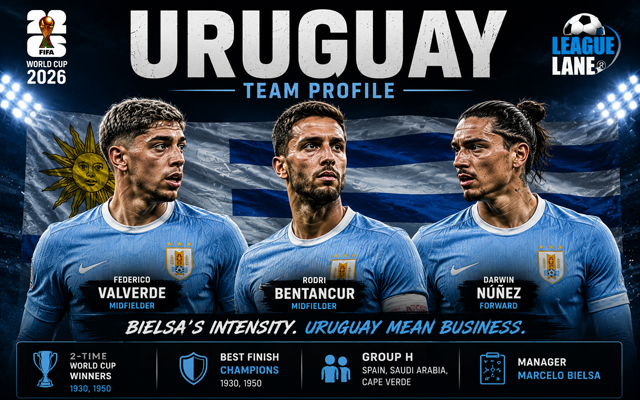
Uruguay arrive at the 2026 World Cup as two-time champions, dark horses, and one of the most tactically interesting teams in the tournament. Marcelo Bielsa has rebuilt La Celeste from the wreckage of their 2022 group stage exit and the end of the Suarez and Cavani era, creating a side that presses relentlessly, defends with genuine quality and carries real attacking threat through a world-class midfield.
This is a transitional Uruguay squad in terms of personnel, but under Bielsa it is a cohesive, dangerous unit. Uruguay are drawn in Group H of the 2026 FIFA World Cup alongside Spain, Saudi Arabia and Cape Verde. For all our World Cup 2026 predictions and analysis visit LeagueLane.
The squad Bielsa has named is built around an outstanding defensive partnership and a midfield trio that would be the envy of most nations in this tournament. Darwin Nunez leads the line despite a difficult spell at club level and Luis Suarez, the all-time top scorer, has been left out entirely; a statement of intent from a manager who is building for the future rather than the past.
The opener against Saudi Arabia on June 15 in Miami is the game that sets the tone. Win it and Uruguay control their own destiny in Group H.
Appearances: 14 | Best finish: Winners (1930, 1950) | Group stage exit in 2022
Uruguay’s World Cup story is unlike any other. They hosted and won the very first tournament in 1930, beating Argentina 4-2 in the final at the Estadio Centenario in Montevideo. Twenty years later they produced one of the greatest upsets in football history, defeating hosts Brazil 2-1 in what became known as the Maracanazo; Brazil needed only a draw to be crowned champions, but goals from Juan Alberto Schiaffino and Alcides Ghiggia silenced a crowd of nearly 200,000 at the Maracana. Two world titles from two appearances remains the defining achievement in Uruguayan football history.
What followed was a long period of inconsistency. Uruguay boycotted 1934 and 1938, returned to finish fourth in 1954, then missed the 1958 tournament entirely. The 1960s and 1970s brought mixed results; a quarter-final in 1966 before losing 4-0 to West Germany, fourth place again in 1970, and then a dispiriting group stage exit in 1974. From 1978 to 2006 they qualified for just three of eight tournaments, going out in the round of 16 twice (1986 and 1990) and suffering a group stage exit in 2002.
The modern era brought renewed relevance. In 2010 in South Africa, Diego Forlan, Luis Suarez and a Diego Lugano-captained team reached the semi-finals, losing to the Netherlands before beating Germany in the third-place playoff to finish fourth. It remains Uruguay’s finest modern hour. In 2014 they went out in the round of 16 to Colombia and in 2018 they reached the quarter-finals before losing to France, the eventual champions. In 2022 they suffered a group stage exit in Qatar, going out on goal difference despite finishing level on points with South Korea. That painful ending is the wound this Bielsa side is determined to heal.
Bielsa is one of the most influential figures in world football, a manager whose ideas have shaped an entire generation of coaches including Pep Guardiola, who has publicly called him the best manager in the world. He took charge of Uruguay in 2023 following their Qatar exit and has applied his characteristic intensity from the first day; demanding physical fitness, tactical discipline and a pressing style that leaves opponents with no time to think. His record managing Chile and Argentina at previous World Cups gave him an understanding of the South American game that few non-Uruguayan managers could bring to the role.
What Bielsa has achieved in qualifying is significant beyond just the results. He beat Brazil 2-0 in Montevideo, ending their 22-year unbeaten run against Uruguay in official matches, and then beat Argentina 2-0 away, ending their decade-long unbeaten run against Uruguay and giving the squad a belief in themselves that had been absent for years. The Suarez omission is the most telling decision of his tenure; by leaving out the 39-year-old all-time top scorer on tactical rather than personal grounds, Bielsa sent a clear signal about the direction of this team. This is not a squad built around icons. It is a squad built around a system.
Formation: 4-3-3 / 4-2-3-1
Bielsa uses a high-pressing 4-3-3 as his base system, with the ability to shift into a 4-2-3-1 depending on the opposition. The defensive line sits high and presses aggressively from the front; the system demands enormous physical output from every player and is designed to suffocate opponents in their own half before they can build. When Uruguay win the ball back they transition quickly and vertically, looking to get Darwin Nunez in behind or pull the midfield runners into dangerous positions.
The midfield trio of Valverde, Ugarte and Bentancur is the heart of everything. Ugarte sits deepest, winning the ball and recycling possession. Bentancur provides composure and tempo from the left centre-midfield role. Valverde plays with the freedom to carry forward, shoot and contribute in the final third, making him the most dangerous of the three from a goal and assist perspective. Araujo and Gimenez at centre-back are among the best defensive partnerships in the tournament and give Bielsa the platform to press high without fear of being exposed on the counter.
Valverde is Uruguay’s best player and one of the finest midfielders in world football. At Real Madrid in 2025-26 he contributed to 16 goals across all competitions by the end of March, scoring eight and assisting eight, including a hat-trick against Manchester City in the Champions League. He is relentless in his energy, capable of playing at right-back, central midfield or as a box-to-box runner depending on what the team needs, and brings a physicality and competitive intensity that defines how Bielsa wants Uruguay to play. He arrives at this World Cup in the best form of his career.
Araujo is arguably the best centre-back in La Liga and one of the best defenders in the world when fit. He returned from a significant hamstring injury that cost him months at Barcelona and has been central to Bielsa’s defensive structure throughout qualifying. His pace, aerial ability and aggressive defending make him the ideal centre-back for a team that presses high and needs a defender who can deal with the space left in behind. His partnership with Jose Maria Gimenez is the defensive foundation on which everything else Uruguay do is built.
Gimenez captains Uruguay and approaches his 100th international cap at this tournament. He has been Diego Simeone’s first-choice centre-back at Atletico Madrid for years and brings the same defensive tenacity, leadership and organisational quality to the national team. His experience of high-pressure European football at the very highest level, combined with Araujo’s athleticism alongside him, gives Uruguay a central defensive partnership that few teams in Group H can match. Gimenez sets the tone from the back and his voice in the dressing room is as important as his performances on the pitch.
Nunez left Liverpool in the summer of 2025 after three inconsistent years at Anfield and joined Al-Hilal in Saudi Arabia. His club form has been mixed but Bielsa has retained full confidence in him as Uruguay’s primary striker and his selection over Suarez tells you everything about the manager’s tactical priorities. Nunez is the kind of centre-forward Bielsa’s high-pressing system needs; explosive, physical, capable of running in behind and pressing from the front. Whether he can deliver the consistent finishing this stage demands is the central question around Uruguay’s tournament.
Ugarte is one of the most effective defensive midfielders in European football and his presence alongside Valverde and Bentancur gives Uruguay a midfield with an outstanding balance of destruction and creation. At Manchester United he has been one of the few consistent performers in a difficult season and arrives at this World Cup with his reputation firmly intact. His ability to win the ball, protect the defensive line and quickly recycle possession to the more creative players around him is exactly what Bielsa’s system demands from the holding midfield role.
Muslera’s inclusion is one of the great stories of this squad. The 39-year-old came out of international retirement for what will be a record fifth World Cup appearance for Uruguay, surpassing his own record as the most-capped goalkeeper in the country’s history. He is not selected on sentiment; Muslera remains first choice at Galatasaray and his experience, leadership and knowledge of the national team system gives Bielsa exactly the kind of presence he wants behind the defence in a high-stakes tournament.
Uruguay finish second in Group H and that is the betting call worth making. The Saudi Arabia game on June 15 is the one that matters most in the short term; win it and the path to the knockout rounds is clear. Cape Verde will make matchday two uncomfortable but Uruguay have too much quality to drop points against a side making their World Cup debut. The Spain game on June 26 in Guadalajara is the standout fixture of the group but both teams should have qualified by then, which means Bielsa will be making decisions about how much to expose his hand before the knockout rounds begin.
The betting angle worth considering is Uruguay to qualify from Group H at odds that reflect their status as clear second favourites. Beyond the group stage, a team with this midfield and this defensive partnership is capable of beating anyone on their day. Bielsa has managed at two previous World Cups and knows what it takes to build through a tournament. If Valverde is at the level he has been at for Real Madrid this season, Uruguay are a genuine threat in the knockout rounds.
The concern is Darwin Nunez. Uruguay’s tournament may ultimately rise or fall on whether he can rediscover the form that made him one of the most exciting strikers in European football before his Liverpool years deflated his confidence. If he fires, Uruguay go deep. If he struggles, Bielsa does not have a natural replacement of similar quality and the goals will have to come from the midfield runners. It is not an impossible ask from Valverde and company, but it is a vulnerability that opponents will look to exploit.