Back
Back
Arun - June 4, 2026
Saudi Arabia arrive at the 2026 World Cup carrying one of the most dramatic pre-tournament stories of any nation in the field. Weeks before their opening game against Uruguay, they sacked their manager, appointed a replacement with no senior international experience, and headed to North America with a squad made up almost entirely of Saudi Pro League players.
None of that means they cannot make the group stage uncomfortable for the other three teams. Saudi Arabia have already shown, against Argentina in 2022, that they are capable of producing a result that shocks the world.
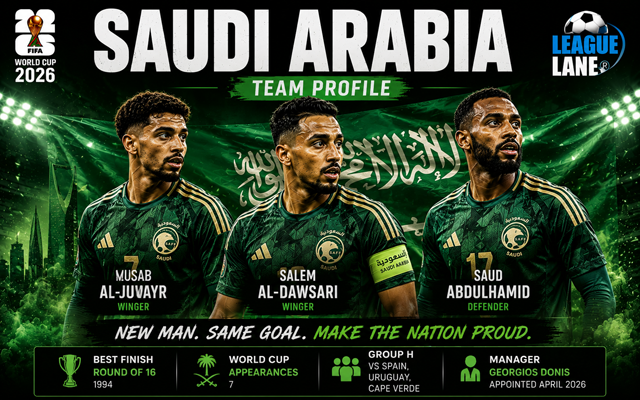
Saudi Arabia are drawn in Group H of the 2026 FIFA World Cup alongside Spain, Uruguay and Cape Verde. For all our World Cup 2026 predictions and analysis visit LeagueLane.
The challenge for Georgios Donis, appointed on April 23 just six weeks before Saudi Arabia’s opener, is to take a squad built around a settled Saudi Pro League core and organise it quickly enough to be competitive in a group that contains two former world champions.
Seven players from the starting eleven that beat Argentina in Qatar are still here, including captain Salem Al-Dawsari. The continuity in the playing group is real. The disruption on the touchline is a significant problem that Saudi Arabia’s opponents will be watching very carefully.
Appearances: 7 | Best finish: Round of 16 (1994) | Group stage exit in 2022
Saudi Arabia made their World Cup debut in 1994 in the United States and it remains the high point of their tournament history. Coached by Argentine Jorge Solari, they beat Belgium 1-0 in a game remembered for Saeed Al-Owairan’s extraordinary solo goal, one of the great individual moments in World Cup history, and Morocco 2-1 to reach the round of 16, where Sweden proved too strong and won 3-1. For a nation making its first appearance on the biggest stage of world football, it was a statement of intent that still resonates.
What followed was a long period of underachievement. Group stage exits in 1998, 2002, 2006 and 2018 told a story of a team that qualified regularly but consistently fell short of the knockout rounds. The lowest point came in 2002 when Germany beat them 8-0, the heaviest defeat in Saudi World Cup history. They missed out altogether in 2010 and 2014 before returning in 2018 under Renard, where they lost their opener 5-0 to the hosts Russia.
Then came Qatar 2022 and the result that changed everything. Saudi Arabia beat Argentina 2-1 in one of the greatest upsets in World Cup history. Saleh Al-Shehri levelled after Messi’s opener and Salem Al-Dawsari scored the winner to silence a stadium full of disbelieving Argentines. It was a moment that announced Saudi football to the world in a way that no result before it had managed. They could not sustain it; defeats to Poland and Mexico sent them home in the group stage. But the belief that performance created is still alive in this squad.
Donis was born in Frankfurt to Greek parents and played as a midfielder for Panathinaikos, Blackburn Rovers, AEK Athens and Huddersfield Town, earning 24 caps for Greece and becoming the first Greek player to appear in the Premier League. His managerial career has taken him across Greece and the Middle East, with spells at AEK Athens, PAOK, APOEL, Panathinaikos and several Saudi clubs including Al-Hilal, where he won the King’s Cup, Crown Prince Cup and Saudi Super Cup in 2015. His most recent club post was at Al-Khaleej in the Saudi Pro League.
The circumstances of his appointment are the central story of Saudi Arabia’s tournament. Herve Renard, who had overseen qualification and whose record included the historic 2022 win over Argentina, was sacked on April 17 following back-to-back friendly defeats. Six days later Donis was appointed on a contract running until July 2027. He has never managed a senior international team before. His familiarity with Saudi club football and the players in this squad is the strongest argument in his favour. Whether six weeks is enough time to prepare a coherent tactical plan for a World Cup group containing Spain and Uruguay is the question that will define his tenure from the first whistle.
Formation: 4-3-3 / 4-2-3-1
Donis built his Saudi club sides around defensive organisation, hard pressing in transition and quick vertical play when the ball is won back. At Al-Khaleej he operated primarily with a 4-3-3 that could shift into a 4-2-3-1 against stronger opposition, using the extra midfield body to protect the defensive line. The pattern is likely to be replicated at international level, though the quality of opponents in Group H will test the system far more severely than anything Donis has faced in domestic Saudi football.
The most important tactical question for Saudi Arabia is how Donis deploys Al-Dawsari. The captain operates as a left winger at Al-Hilal but has the quality to take up a more central role when the team needs him to create rather than run in behind. Against Spain and Uruguay, Saudi Arabia will defend deep and look to exploit transitions. Against Cape Verde on matchday three, they will need to be the team that takes the game to the opposition and creates enough to win. Whether Donis has had enough time to build those two different tactical approaches is far from certain.
Al-Dawsari is the heart and soul of this Saudi Arabia team and has been for the better part of a decade. The 108-cap captain scored the winning goal against Argentina in Qatar 2022, one of the most famous goals in recent World Cup history, and arrives at his third World Cup as the most experienced and influential player in the squad. At Al-Hilal he competes regularly against the best players in Asian football and his quality, directness and ability to score in big moments make him the one Saudi player capable of changing a game on his own. If Saudi Arabia are going to cause an upset in Group H, Al-Dawsari will be at the centre of it.
Abdulhamid is the only player in the Saudi squad based outside the Saudi Pro League and his European experience makes him one of the most important technical contributors in Donis’s setup. He spent the season at RC Lens in Ligue 1 and won the Coupe de France with them in May 2026, making him the first Saudi player to win a major domestic honour in European football. As a right-back he combines defensive solidity with a genuine attacking threat from wide areas and his understanding of the game at a higher level than Saudi domestic football offers a quality the rest of the squad can lean on.
Al-Buraikan was one of the most prolific strikers in Saudi World Cup qualifying and arrives at this tournament as Donis’s first-choice centre-forward. Quick, direct and with a good eye for goal, he led the line in qualifying with an energy and work rate that suits the counter-pressing style Donis wants to implement. He has not been tested consistently against the quality of opposition Saudi Arabia will face in Group H, but his pace and movement give the team a forward option capable of exploiting the spaces Spain and Uruguay leave in behind when they press.
Al-Owais is one of the most experienced goalkeepers in Asian football and a key returning presence from the 2022 squad that beat Argentina. His shot-stopping quality and command of his area are significantly above the standard of most domestic keepers in the Saudi Pro League and he will be Saudi Arabia’s last line of defence against the attacking quality of Spain and Uruguay. His experience of a World Cup environment, having played in Qatar, is a significant advantage in a squad that will otherwise be stepping onto the biggest stage for the first time.
Kanno is Saudi Arabia’s midfield anchor and another returning figure from 2022. He sits deep, protects the defensive line and provides the platform from which Al-Dawsari and the wider players can operate. At Al-Hilal he is part of one of the most ambitious club projects in world football and that exposure to high-level competition on a weekly basis gives him a quality and composure that sets him apart from many of his national team colleagues. His discipline and organisation in the centre of the pitch is what gives Saudi Arabia their defensive shape when they are without the ball.
Saudi Arabia’s World Cup will be defined by one game: Cape Verde on June 26 in Houston. They will not beat Spain or Uruguay and the betting case for them taking points from either of those fixtures is very slim. But the Cape Verde game is genuinely open and Saudi Arabia, for all the managerial disruption, have a squad with enough quality and enough 2022 experience to win a knockout-style game against a debutant nation.
The managerial change is the overwhelming concern. Donis has six weeks to prepare a national team for a World Cup group containing two former champions. He knows Saudi club football inside out and several players in this squad have worked under him directly at Al-Hilal, Al-Fateh and Al-Khaleej. That familiarity matters. But there is no shortcut to international tournament preparation and the disruption caused by sacking Renard, a manager whose record included the Argentina result and full qualification campaign, is a decision that raises serious questions about the federation’s judgement.
From a betting perspective, Saudi Arabia are best left alone in the win market for their first two games. The Cape Verde game at odds for a Saudi win is the angle worth considering, not because Saudi Arabia will be good, but because Cape Verde will be navigating the pressure of a must-win World Cup game for the first time in their history. Al-Dawsari’s experience in that kind of moment is worth something. The Green Falcons will not embarrass themselves in North America. Whether they can do enough to survive the group stage is a much harder question to answer.