Back
Back
Peter Green - June 4, 2026
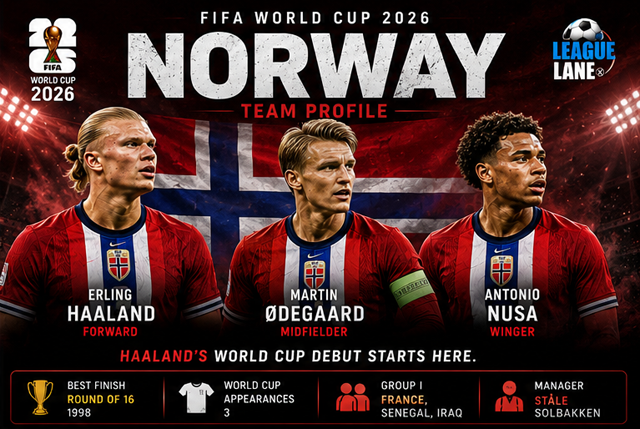
Norway return to the World Cup after 28 years away with the most exciting squad in their history and a striker who is already one of the greatest goalscorers the game has ever seen.
Stale Solbakken’s side won all eight of their qualifying matches, beating Italy home and away along the way, and arrive at this tournament with a system built around Erling Haaland and Martin Odegaard that is capable of hurting anyone in the world on their best day.
Norway are drawn in Group I of the 2026 FIFA World Cup alongside France, Senegal and Iraq. For all our World Cup 2026 predictions and analysis visit LeagueLane.
The last time Norway were at a World Cup was 1998 in France, when they produced one of the great results of that tournament by beating Brazil 2-1 in the group stage before losing to Italy in the round of 16. A generation of players has missed out on this stage entirely. Now, with Haaland making his World Cup debut and Odegaard at the peak of his powers after leading Arsenal to the Premier League title, there is a genuine belief that Norway can go deep. The opener against Iraq on June 16 in Foxborough is the platform everything else is built on.
Appearances: 4 | Best finish: Round of 16 (1938, 1998) | Group stage exit in 1994
Norway made their World Cup debut in 1938 in France, losing to Italy in the first round after extra time. They would not return to the tournament for 56 years. In 1994 in the United States they appeared in one of the most remarkable groups in World Cup history; Group E with Italy, the Republic of Ireland and Mexico, in which all four teams finished on four points with identical goal differences. Norway went out on goals scored, having scored only once in their three matches despite beating Mexico 1-0 and losing narrowly to Italy. It remains the only group in World Cup history where all four teams finished level on both points and goal difference.
The 1998 tournament in France was Norway’s finest hour. They drew with Morocco and Scotland before facing an already-qualified Brazil needing a win to go through. In the 83rd minute, Tore Andre Flo’s persistence in the penalty area drew a foul and Kjetil Rekdal converted the spot-kick to complete a 2-1 comeback victory that knocked Morocco out and sent Norway into the round of 16. They then lost to Italy. It was a result that still resonates in Norwegian football and the storyline of Norway at this World Cup begins with that memory. After 28 years, a new generation gets its chance.
Solbakken is in his second spell as Norway manager, having previously been in charge between 2008 and 2011. He returned in 2021 and has transformed a squad with tremendous individual talent into a coherent, functioning system. His work at Copenhagen and other clubs gave him the tactical foundations and his deep familiarity with the Norwegian football culture gives him an authority with this group of players that a foreign manager could not replicate. The perfect qualifying record of eight wins from eight, including the double over Italy, is the clearest evidence that the system works.
Solbakken is a progressive coach who has evolved his approach over the years. He asks Norway to press high, win the ball quickly and transition vertically. The full-backs push high and wide to create space for Haaland’s runs in behind. Odegaard operates in the pockets between midfield and attack, finding passes that unlock defences. The system is demanding physically but this squad has the quality and the fitness to execute it consistently across three group games.
Formation: 4-3-3
Solbakken’s 4-3-3 is built around Haaland as the central reference point; deep runs, intelligent movement and the finishing quality to convert the smallest of chances. Odegaard operates as the most advanced of the three central midfielders, providing the link between midfield and attack and creating chances through his passing vision and movement. Sander Berge provides the defensive platform that allows Odegaard to get forward and Thorstvedt provides a balance between the two. The wide forwards, typically Nusa and Sorloth, provide width and the ability to come inside or hold their positions depending on what the game demands.
When Norway lose the ball they press immediately and aggressively. Haaland leads the press from the front, which is not something every striker does willingly, and the intensity with which Norway hunt the ball back in the opponent’s half is one of the most impressive aspects of Solbakken’s system. Their defensive line sits higher than most teams in this group and the risk of being caught on the counter is real, particularly against France and Senegal. But Norway’s quality and organisation in transition means they are more than capable of living with that risk.
Haaland is the most prolific striker at this tournament and arguably the most feared finisher in world football. He has 55 goals in 48 appearances for Norway, a record that stands comparison with any striker in the history of the international game. In qualifying he scored 16 goals in eight matches. At Manchester City he has broken Premier League scoring records that many thought would never be challenged. His combination of raw pace, physical strength, intelligent movement and clinical finishing makes him a nightmare for any defensive partnership in this group. This is his World Cup debut and the expectation that comes with that will not faze a player who has performed under pressure since his teenage years.
Odegaard captains both Arsenal and Norway and arrives at this World Cup having just led the Gunners to the Premier League title, their first in 22 years. His creative quality, his vision and his ability to control the tempo of a game make him the essential link between Norway’s defensive structure and Haaland’s goal threat. His injury record in recent seasons has been a concern, but he arrives fit and in outstanding form. When Odegaard is at his best, Norway are a genuinely different team; the combinations he creates with Haaland are among the most potent attacking partnerships in international football.
Sorloth is the alternative to Haaland and a player of genuine quality in his own right. At Atletico Madrid under Diego Simeone he has developed into one of the best target forwards in La Liga, using his physicality, aerial ability and intelligent movement to create and score goals at the highest level. He gives Solbakken the option to use two physical forwards together when the game demands it, or to rotate Haaland to manage his minutes across a tournament. Sorloth’s experience and quality makes Norway’s attacking options deeper than most nations in this group.
Bobb is one of Norway’s most exciting young talents, a wide player with pace, technique and the ability to take defenders on in one-on-one situations. He spent the season on loan at Fulham from Manchester City and his development in the Premier League has been evident in how Solbakken uses him. His directness and energy give Norway a different kind of threat from wide areas and at 22 he is a player who will only get better. His contribution from the bench or from the start gives Solbakken real tactical flexibility.
Berge is the anchor of Norway’s midfield and the defensive foundation that allows Odegaard to get forward without leaving the team exposed. At Fulham he has been one of the most consistent midfielders in the Premier League over recent seasons, winning the ball, recycling possession and organising the defensive shape when Norway are out of possession. His physical presence and his composure in tight situations are exactly what Solbakken needs from the holding midfield role.
Norway finish second in Group I if they take care of business against Iraq on matchday one and back it up against Senegal six days later. Neither of those results is guaranteed but both are achievable for a side of Norway’s quality. Haaland will score goals in this tournament; the only question is how many and against whom. Backing him to finish as one of the tournament’s top scorers is among the best betting propositions in the whole competition.
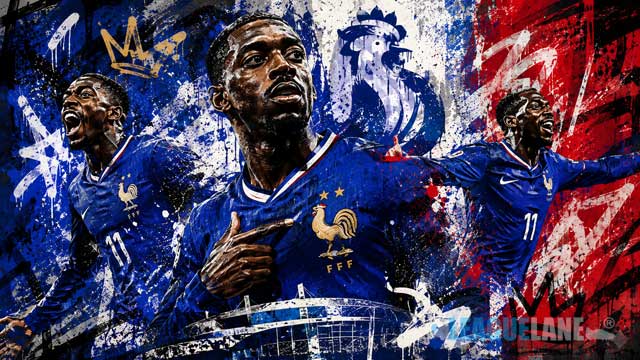
The France game on June 26 is the one that tells us whether Norway are truly ready for the knockout rounds. If second place is already secured, Solbakken may rotate. If the group is still alive, he will want his best team on the pitch against Deschamps and that is a game Norway can genuinely compete in. The Haaland-Dembele-Mbappe combination of both squads makes it one of the most watchable games of the group stage.
From a betting perspective, Norway to qualify from Group I is the value bet and Haaland to score at least three goals across the group stage is a reasonable expectation given his record and the opposition he will face. This is a squad that can cause problems for anyone in the knockout rounds if they get there with confidence. After 28 years away, Norway are ready.