Back
Back
Peter Green - June 4, 2026
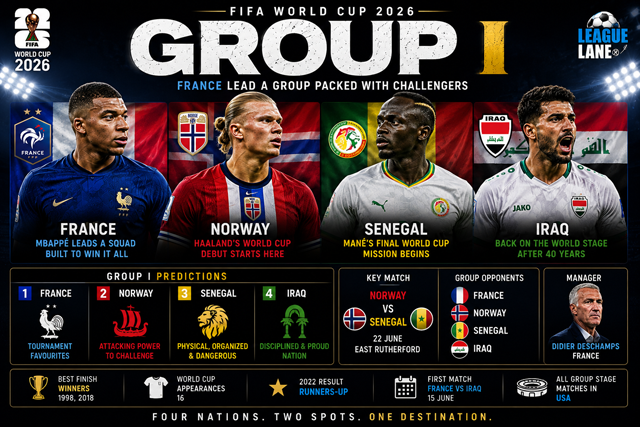
Group I at the 2026 World Cup is one of the most compelling groups in the tournament. France arrive as 2022 runners-up and one of the genuine title favourites, with Kylian Mbappe leading a squad deep enough to cope with almost anything.
But the group is far from a formality. Norway are making their first World Cup appearance in 28 years with a generational talent in Erling Haaland leading the line and a system under Stale Solbakken that has been almost perfect in qualifying.
Senegal are one of the most dangerous African sides at the tournament, armed with Sadio Mane in what will be his final World Cup and a squad littered with Premier League and European quality.
And Iraq return to the biggest stage after 40 years away, an emotional comeback that carries the hopes of an entire nation. For all our World Cup 2026 predictions and analysis visit LeagueLane.
France are clear favourites to win this group and that is the only real certainty in Group I and it is a safe one. The question that makes this group genuinely interesting is who finishes second.
Norway have the attacking firepower to beat Senegal and Iraq comfortably. Senegal have the organisation, the physicality and the individual quality to make life very difficult for Norway.
Iraq will frustrate everyone but are unlikely to find the goals needed to take points from any of the three teams above them. The Norway versus Senegal game on June 22 in East Rutherford is the defining fixture of Group I and the one that will decide who joins France in the knockout rounds.
France arrive at this tournament as one of three or four sides capable of winning it outright. Two-time world champions, 2022 finalists, FIFA’s number one ranked nation; the credentials speak for themselves.
Didier Deschamps, who won the World Cup as a player in 1998 and as a manager in 2018, has confirmed this will be his last tournament in charge before stepping down. He will be desperate to sign off with a third star and the squad he has assembled gives him every chance.
Kylian Mbappe captains the side at Real Madrid and arrives at his third World Cup as the most dangerous attacker on the planet. Ousmane Dembele, the reigning Ballon d’Or winner, provides the creative spark from wide areas. William Saliba anchors a defence of genuine quality and Mike Maignan is one of the best goalkeepers in the world behind them. The notable absence is Antoine Griezmann, who retired from international football in 2024 and will watch from the stands. France are not a team without vulnerabilities; Deschamps has been criticised for a conservative approach that sometimes stifles the attacking talent at his disposal. But in a group containing Senegal, Norway and Iraq, they have far too much quality to slip up.
Prediction: France top Group I without dropping points. Their squad depth and individual quality are in a different bracket to the other three teams and Deschamps has the tournament experience to manage the group stage efficiently.
Norway return to the World Cup for the first time since 1998 and they do so with a squad that is genuinely capable of going deep in this tournament.
Stale Solbakken’s side won all eight of their qualifying matches, including home and away victories over Italy, and built a system around Erling Haaland and Martin Odegaard that is among the most potent attacking combinations at the tournament.
After 28 years away from this stage, there is a hunger and energy about this squad that makes them a genuine threat.
Haaland has 55 goals in 48 appearances for Norway and arrives at his first World Cup having just completed another extraordinary season at Manchester City. Odegaard, the Arsenal captain who led the Gunners to the Premier League title, pulls the strings behind him.
Alexander Sorloth at Atletico Madrid provides an alternative to Haaland when Norway want a different profile up front, and Antonio Nusa at RB Leipzig gives them wide pace and directness.
The opener against Iraq is a must-win. Win that and Norway control their own destiny heading into the defining game against Senegal.
Prediction: Norway finish second in Group I if they beat Iraq on matchday one and back it up against Senegal. Haaland’s debut World Cup is the story of the group and backing him to score in multiple games is the betting angle worth considering.
Senegal arrive at their fourth World Cup as arguably the most complete side Africa has produced in this tournament cycle. Pape Thiaw has built a team that is physically formidable, defensively disciplined and carries real attacking threat through Sadio Mane, Nicolas Jackson and Iliman Ndiaye. They won the 2025 Africa Cup of Nations and qualified for this tournament without losing a game. Mane himself has confirmed this will be his last World Cup and at 34 his leadership and match-winning ability at tournament level remains one of the most potent weapons in the group.
Senegal’s best World Cup performance remains their debut in 2002, when they beat defending champions France in the opening game and reached the quarter-finals. They have been trying to match that ever since; a yellow card elimination in 2018 and a round of 16 exit to England in 2022 kept them short of it. This squad has the experience, the quality and the motivation to go further than any Senegal side since. Kalidou Koulibaly leads the defence from the back, Idrissa Gana Gueye and Pape Matar Sarr control the midfield, and the attacking trio can hurt any team in this group.
Strengths: One of the most physically imposing squads in the tournament; Mane’s experience and leadership in big games is irreplaceable; Koulibaly and Niakhate form a formidable central defensive partnership
Vulnerabilities: Their reliance on Mane at 34 is a risk if he is not at his best; the midfield can be bypassed by teams with quick transitions; the 2018 and 2022 exits show a pattern of falling short when it matters most
Prediction: Senegal finish second or third depending on the Norway game. Their organisation and physicality will see off Iraq comfortably. The Norway match on June 22 is the one that defines their tournament.
Iraq return to the World Cup for the first time in 40 years and the emotional weight of that comeback is impossible to overstate. Graham Arnold’s side qualified through the inter-confederation playoff, beating Bolivia 2-1 in Monterrey in March 2026 to clinch the last spot in the tournament. Their only previous World Cup in 1986 in Mexico ended with three defeats from three games. This team will not want to repeat that experience.
Arnold has built Iraq around defensive discipline and collective organisation. They are hard to break down, dangerous from set pieces and capable of making life uncomfortable for teams that expect a straightforward game. Aymen Hussein leads the line with more than 90 senior caps; Zidane Iqbal provides creativity and composure in midfield; Ali Jasim, on the books at Como in Serie A, offers pace and directness from wide positions. The reality is that this group is an enormous challenge and progress beyond the group stage is unlikely. But Iraq will not embarrass themselves and at least one of their three opponents will find them harder work than expected.
Strengths: Collective organisation under Arnold is the strongest in the group; Zidane Iqbal is a quality operator in midfield; the emotional energy of a 40-year return gives this squad a motivation that is hard to quantify
Vulnerabilities: The squad lacks the individual quality to hurt France or Norway over 90 minutes; limited European-based players means the step up in standard is significant; no experience of tournament football at this level in living memory
Prediction: Iraq finish fourth. The quality gap against France, Norway and Senegal is too significant but Arnold’s organisation means this will not be a heavy defeat campaign. The Senegal game on June 26 in Toronto is their best chance of a positive result.
16 June: France vs Senegal at MetLife Stadium, East Rutherford, New Jersey
The headline fixture of Group I and one of the most historically charged matchups in world football. Senegal beat France in their very first World Cup game in 2002. France will want immediate revenge and control of the group. If Mane produces a moment, this group becomes very interesting.
16 June: Iraq vs Norway at Gillette Stadium, Foxborough, Massachusetts
The first World Cup match in Iraq’s history since 1986 and Haaland’s World Cup debut. Norway cannot afford to drop points here. Haaland against an Iraqi defence with no World Cup experience for 40 years is the betting play of matchday one.
22 June: France vs Iraq at Lincoln Financial Field, Philadelphia
France should have qualified by this point but will want to maintain momentum. Iraq will defend deep and make it difficult. Deschamps may rotate and France’s depth will be tested for the first time.
22 June: Norway vs Senegal at MetLife Stadium, East Rutherford, New Jersey
The defining fixture of Group I. This game decides second place. Haaland versus Koulibaly, Odegaard versus Gueye, pace against physicality. Norway need to win; Senegal need at least a draw. It is the best game of the group stage in this pool.
26 June: Norway vs France at Gillette Stadium, Foxborough, Massachusetts
If both teams have qualified, this becomes a group winner decider. If Norway have already secured second, Solbakken may rest players ahead of the knockout rounds. Either way, a fascinating tactical contest between two of the best managers in the group.
26 June: Senegal vs Iraq at BMO Field, Toronto
Running simultaneously. If Senegal’s second place is still in doubt, they need to win this. Iraq will see it as their best chance of a result in the group. Mane’s last tournament means Senegal will not take this lightly.
France go through as group winners and that is not a difficult call. Mbappe, Dembele and a defence marshalled by Saliba is simply too good for Senegal, Norway and Iraq at group stage level. The only real question around France is whether Deschamps’ conservative approach costs them when they face genuinely elite opposition in the knockout rounds.
Second place is the real story of Group I and it comes down to one game. Norway versus Senegal on June 22 in East Rutherford is the most important 90 minutes in the group. Norway have the attacking quality to win it; Haaland and Odegaard together are the most dangerous combination either team will face. But Senegal are not a side that concedes cheaply and their physical intensity can disrupt the most organised pressing systems. It is genuinely 50-50 and the betting value lies in backing Haaland to score at odds that reflect his extraordinary record at this level.
Iraq will come home proud. They qualified through one of the most gruelling routes to this tournament, beat Bolivia in the playoff when no one expected them to, and arrived with Arnold’s organisation and the collective belief that comes from having earned their place. They will not progress but they will make everyone work and the 40-year absence means this group stage run carries a significance beyond football.