Back
Back
Peter Green - June 4, 2026
France arrive at the 2026 World Cup as one of the two or three teams genuinely capable of winning the tournament outright. Two-time world champions, 2022 runners-up, FIFA’s number one ranked nation heading into the competition.
Didier Deschamps has built something that is deep, experienced and ruthless in knockout football. This will be Deschamps’ last tournament as manager; he has confirmed he will not extend his contract beyond 2026. He leaves wanting a third star and the squad at his disposal gives him every chance.
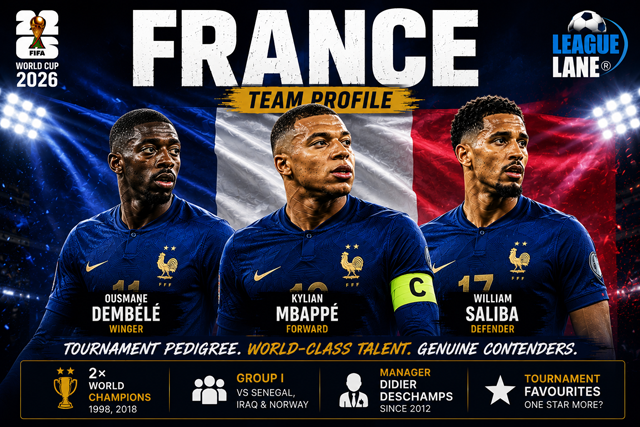
France are drawn in Group I of the 2026 FIFA World Cup alongside Senegal, Iraq and Norway. For all our World Cup 2026 predictions and analysis visit LeagueLane.
The opening fixture against Senegal at MetLife Stadium on June 16 is the group’s most charged match. Senegal beat France in their very first World Cup game in 2002, one of the great upsets in tournament history, and there is history between these two nations that goes far beyond football.
France will want to set the right tone immediately. Norway on matchday three is the most tactically interesting game in the group; a clash between two of the best attacking systems in the tournament.
But France should manage their way through all three games and arrive in the knockout rounds fresh and dangerous.
Appearances: 17 | Best finish: Winners (1998, 2018) | Runners-up in 2022
France have one of the richest World Cup histories of any nation. They were present at the inaugural 1930 tournament in Uruguay and have been a constant presence at the highest level of the game for nearly a century.
Their early record was mixed; a group stage exit in 1930, a last-16 appearance in 1934, a quarter-final in 1938 as hosts, and a remarkable run to third place in 1954 Sweden when Just Fontaine scored 13 goals in six games, a record for a single tournament that still stands. After a quarter-final in 1938 they went through lean periods; group exits in 1966 and 1978 and did not qualify at all for 1990 or 1994.
The transformation came in 1998 on home soil. Zinedine Zidane’s France beat Brazil 3-0 in the final at the Stade de France, with Zidane scoring twice. It was the greatest moment in the history of French football. They reached the fourth place in 1982 and third place in 1986 under Michel Platini before the fallow years, but 1998 reset everything.
A group stage exit in 2002 as defending champions, a runners-up finish in 2006 when Zidane headbutted Marco Materazzi in the final, and a return to form in 2014 with a quarter-final exit to Germany followed. Then in 2018 came the second title; a 4-2 victory over Croatia in Moscow, with goals from Umtiti, Pogba and Mbappe alongside an own goal and a penalty.
In 2022 they reached the final again, losing to Argentina on penalties in one of the greatest games in World Cup history. France have been in four finals and won two. Deschamps wants to make it three.
Deschamps is one of only three men to have won the World Cup as both a player and a manager, alongside Brazil’s Mario Zagallo and Germany’s Franz Beckenbauer. He lifted the trophy as captain in 1998 and as manager in 2018 and his record at international level is remarkable; a Nations League title, two World Cup finals and a consistent ability to get the best out of a squad of extraordinary attacking talent while maintaining defensive solidity. He has been criticised throughout his tenure for pragmatism over flair, for leaving some of France’s most gifted players on the bench, but his results have silenced most of those critics.
This will be his last tournament. He confirmed in the build-up that he will not renew his contract when it expires after the 2026 World Cup. His motivations for this final campaign are clear; a third World Cup title would cement his legacy as the greatest manager in French football history. The squad is the strongest he has had at a tournament and the group draw is manageable. Deschamps will not take unnecessary risks but he will not be conservative to the point of being predictable either.
Formation: 4-2-3-1
Deschamps uses a 4-2-3-1 as his base, with the double pivot providing defensive cover that allows the wide players and the number ten to operate with freedom. The left full-back pushes high when France have the ball, creating an overload and allowing the left winger to move into central pockets. The pressing is aggressive and organised; France do not sit back and invite pressure, they set traps and look to win the ball high up the pitch before transitioning quickly. When they have the ball they are patient and precise; when they lose it they press immediately.
The key to the system is the flexibility between Mbappe and Dembele. Mbappe operates from the left and cuts inside onto his stronger right foot; Dembele does the same from the right on his stronger left. Both can combine centrally or operate in isolation. This creates enormous problems for defenders who cannot push up or they leave space in behind, and cannot sit back or they give Mbappe and Dembele time on the ball. Saliba’s composure from the back allows the full-backs to get forward and adds a technical quality to France’s build-up that sets them apart from most tournament sides.
Mbappe is the best player in the world and arrives at his third World Cup as France’s captain and the most dangerous attacker in the tournament. He has scored in major knockout rounds before and his pace, finishing and movement in tight spaces make him almost impossible to neutralise one-on-one. At Real Madrid he has continued to develop as a leader and a match-winner in the biggest games and arrives at this tournament in outstanding form. His record of 48 international goals puts him third in France’s all-time scoring chart and he will be hunting the record throughout this tournament.
Dembele won the Ballon d’Or in 2025 and arrives at this World Cup as the second-most dangerous attacker in France’s squad and one of the best wide players in world football. His ability to beat defenders with both feet, create chances from nothing and score from distance makes him the perfect complement to Mbappe’s direct running. After years of injury interruptions earlier in his career, Dembele has found remarkable consistency and arrives at this tournament at the peak of his powers.
Saliba is the foundation of France’s defensive structure and one of the best centre-backs in European football. His season at Arsenal, where he was central to their Premier League title win, confirmed what French football fans already knew; this is a defender of extraordinary composure, pace and reading of the game. He wins aerial duels, recovers quickly when beaten, communicates well and gives the team behind him a platform to attack. France’s defensive record in qualifying was outstanding and Saliba is the primary reason why.
Maignan is one of the best goalkeepers in the world and France’s undisputed number one after Hugo Lloris’s retirement from international football. His shot-stopping, his distribution and his command of the penalty area give France a goalkeeper who can match any in the tournament. He has won Serie A titles with AC Milan and brings a authority and presence to the back line that makes France a more complete defensive unit. His ability to start attacks with precise distribution is a key part of how Deschamps wants France to play out from the back.
Kante is the oldest outfield player in France’s squad and his inclusion is based entirely on his tournament experience and his ability to control the tempo of games from the bench. He was a World Cup winner in 2018 and his presence in the dressing room and his capacity to come on and change a game gives Deschamps options that most managers would envy. He is no longer the starting force he once was but in a knockout tournament where managing games is as important as winning them, Kante’s intelligence and composure from the bench is a genuine asset.
France win Group I and that is as close to a certainty as this tournament offers. The squad Deschamps has assembled is simply too deep and too talented to drop points against Senegal, Norway or Iraq in the group stage. The real question is not whether France qualify; it is whether they can go all the way and give Deschamps the send-off his career deserves.
The betting angle worth considering is France to win all three group games with at least two clean sheets. Their defensive record in qualifying was outstanding, and Iraq in particular will offer them very little in terms of attacking threat. Mbappe to score in multiple group games is also a sensible play given his record in this stage of tournaments.
The weight of expectation is the only real concern. France have been here before; heavily favoured, seemingly unstoppable, and then found wanting when it mattered most. But this squad is more experienced and more balanced than any Deschamps has had before. If Mbappe is fit and Dembele stays injury-free, France go deep in this tournament. Group I is just the first chapter.