Back
Back
Arun - June 16, 2026
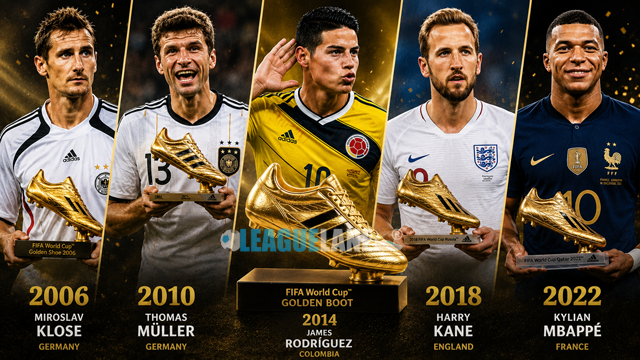
The Golden Boot is awarded to the top scorer at each World Cup, a prize that has been officially presented since 1982, when it was known as the Golden Shoe. Rebranded the Golden Boot ahead of the 2010 tournament in South Africa, the award is decided on goals first, then assists, and finally minutes played if players remain level. With World Cup winner odds reflecting how often the tournament’s top scorer comes from one of the strongest nations in the field, here is a look at the last five winners.
The most extraordinary Golden Boot in the award’s modern history. Mbappe finished the 2022 World Cup in Qatar with eight goals, including a hat-trick in the final against Argentina, the second ever scored in a World Cup final after Geoff Hurst in 1966.
His total would have been enough to win the award at virtually any other tournament, yet the remarkable context is that Lionel Messi finished with seven goals and three assists and still could not match him.
That Mbappe’s hat-trick was not enough to win the final, France losing on penalties, only adds to the extraordinary nature of his individual contribution. He arrived at 2022 as the world’s best player and departed as its most devastating scorer.
Kane’s six goals in Russia announced him to the world as one of the most clinical finishers of his generation and ended England’s long wait for a Golden Boot winner. Five of his six goals came in the group stage alone, including a hat-trick against Panama in England’s record 6-1 victory, and his penalty against Colombia in the round of 16 proved decisive in a tense shootout win.
England reached the semi-finals before losing to Croatia, but Kane’s individual contribution was beyond question. The odds on football markets ahead of 2026 will reflect a striker still attempting to add the second Golden Boot that no player has ever won twice.
The most surprising winner of recent times and the one that launched a career into the stratosphere. Rodriguez scored six goals and added two assists for Colombia in Brazil, netting in every game he played as his nation reached the quarter-finals before being eliminated by the hosts.
His goal against Uruguay, a chest control and volley from 25 yards that won the Puskas Award for goal of the year, was the defining moment of the tournament. He was 22 years old, playing for Monaco, and relatively unknown before the competition began. Real Madrid signed him that summer. His Golden Boot remains the only one ever won by a Colombian player.
Muller’s five goals would have been insufficient to win the award at most tournaments, but the tiebreaker system worked in his favour in South Africa. Four players finished level on five goals: Muller, David Villa, Wesley Sneijder, and Diego Forlan. Muller’s three assists across the tournament to their one each separated him from the pack and gave Germany’s young forward the prize.
He scored four in a quarter-final alone against Argentina, including two in the space of three second-half minutes, and his performances across the tournament confirmed him as one of European football’s most exciting emerging talents.
The last winner of the Golden Shoe before the award was rebranded. Klose scored five goals on home soil in Germany as the hosts reached the semi-finals before losing to Italy, going on to claim third place. His tournament was built on the same qualities that defined his entire career: movement, timing, and an exceptional ability to arrive at the right place at the right moment.
He would go on to become the all-time leading scorer in World Cup history with 16 goals across four tournaments, a record that still stands. The 2006 Golden Shoe was the first individual award of a career that redefined what longevity at the highest level could look like.