Back
Back
Arun - June 17, 2026
The 2026 World Cup will feature 48 nations, and for several of them, the majority of their squad has been assembled from players born and raised outside the country they represent.
Migration patterns, colonial history, and the movement of communities across generations have produced rosters that reflect as much about social history as they do about football development.
In this article, we look at the seven nations arriving in North America with the fewest homegrown players in their squads, and the historical context behind each one. You can follow these nations throughout the tournament via a digital matchday betting experience.
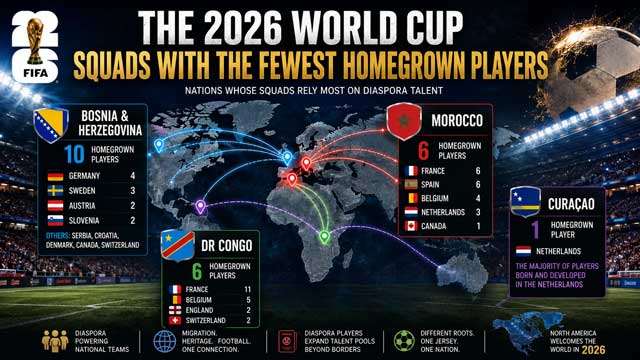
Bosnia and Herzegovina’s squad contained 10 players born in the country. The rest included four born in Germany, three in Sweden, two in Austria, two in Slovenia and others born in Serbia, Croatia, Denmark, Canada and Switzerland.
The roots of this diaspora lie in the breakup of Yugoslavia and the Bosnian War of the 1990s. Hundreds of thousands of Bosnians fled the conflict and settled across Europe and North America. Many children of those refugees later emerged through football systems in their adopted countries while maintaining a strong connection to Bosnia and Herzegovina. The national team became a symbol of a dispersed population reunited through sport.
Morocco’s squad featured just six homegrown players. The remainder reflected one of the largest football diasporas in the world: six players were born in Spain, six in France, four in Belgium, three in the Netherlands and one in Canada.
This pattern can largely be traced to labour migration during the 1960s, 1970s and 1980s, when large numbers of Moroccans moved to Western Europe in search of better economic opportunities. Geography played a major role. Spain lies only a short distance across the Strait of Gibraltar, making it a natural destination for migrants, while France is also relatively close and has long-standing historical and economic links with Morocco dating back to the French protectorate period.
Morocco reached the semi-finals of the 2022 World Cup with a similarly constructed squad, and are now ranked eighth in the World, the first African nation to break into the top 10.
DR Congo’s squad contained only six players born in the country itself. The largest foreign-born group came from France (11), followed by Belgium (five), England (two) and Switzerland (two).
The makeup of the squad reflects the country’s complex history and one of Africa’s largest diasporas. DR Congo was a Belgian colony until independence in 1960, creating lasting links with Belgium. Political instability, economic difficulties, and periods of conflict following independence, particularly during the Congo Wars of the 1990s and early 2000s, led many Congolese families to settle elsewhere in Europe.
Belgium became a major destination due to its colonial ties, while France attracted large numbers of Congolese migrants because of the shared French language and strong cultural connections.
The squad illustrates how migration patterns over several generations have expanded DR Congo’s talent pool far beyond its borders, with diaspora players now playing a central role in the national team’s success.
With the 2026 World Cup expanding to 48 teams and co-hosts the United States, Canada, and Mexico receiving automatic qualification places, additional spots became available to CONCACAF nations. Curacao took advantage of that opportunity, becoming just the seventh non-sovereign nation to reach a World Cup.
Remarkably, only one player in the squad, Tahith Chong, was born in Curacao itself. More people of Curacaoan heritage now live abroad than on the island, particularly in the Netherlands.
As a constituent country of the Kingdom of the Netherlands, anyone born in Curacao is automatically a Dutch citizen. This has allowed generations of Curacaoans to move freely to the Netherlands, where football infrastructure, coaching and academy systems are far more developed than on the island. Many members of the squad therefore came through Dutch youth development pathways before representing their ancestral homeland.
The national team also benefited from active recruitment of Dutch-born players with Curacaoan ancestry, giving the island access to a much larger talent pool than its small population would normally allow. As a result, Curacao’s historic qualification was driven largely by a diaspora developed thousands of miles away.