Back
Back
Peter Green - June 3, 2026
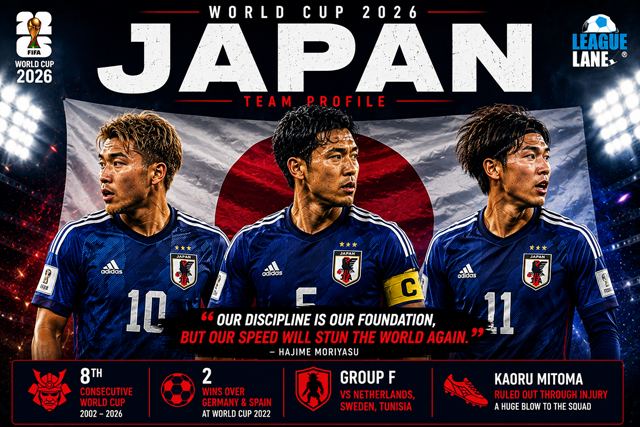
Japan arrive at the 2026 World Cup as the most dangerous underdog in the entire tournament. They beat Germany and Spain at the 2022 World Cup. They beat Germany again in qualifying. They have knocked out European giants in four of their last six major tournament appearances. The Samurai Blue are not here to participate; they are here to cause problems for every team in Group F.
The biggest blow of their preparation has been the loss of Kaoru Mitoma, who suffered a hamstring injury in May and has been ruled out of the entire tournament. Moriyasu described it as a huge blow to the squad, and the tears in his eyes at the press conference said everything. Mitoma is irreplaceable in terms of what he provides from the left wing. But Japan’s squad depth means this is a setback rather than a disaster; the collective is always more important than any individual in Moriyasu’s system.
Japan are drawn in Group F of the 2026 FIFA World Cup alongside the Netherlands, Sweden and Tunisia. For all our World Cup 2026 predictions and analysis visit LeagueLane.
“Our discipline is our foundation, but our speed in transition is how we will stun the world again.” – Hajime Moriyasu
Appearances: 8 | Best finish: Round of 16 (2002, 2010, 2018, 2022) | Beat Germany and Spain in 2022
Japanese · Manager since 2018 · 2nd consecutive World Cup in charge
Hajime Moriyasu is one of the most tactically astute international managers at this tournament. Since taking charge in 2018 he has overseen Japan’s transformation into a genuine World Cup threat; his ability to study opponents during the first half and make perfectly timed substitutions in the second has become his trademark. The 2022 World Cup showed exactly how effective this approach can be; Japan trailed Germany and Spain at half-time in both matches and came back to win both.
His greatest quality is creating a collective environment where even the most talented players subordinate themselves to the team’s needs. Every player presses, every player tracks back, every player accepts being substituted. That selflessness combined with genuine technical quality makes Japan one of the most difficult teams to play against in world football.
Formation: 4-2-3-1 (shifting to 5-4-1 low-block when defending)
Moriyasu lines Japan up in a 4-2-3-1 that transforms into a compact 5-4-1 low-block when facing dominant possession teams like the Netherlands. Japan invite opponents to have the ball in non-threatening positions, then spring their press the moment the opposition makes a mistake. The transition from defence to attack is instant and devastating.
Without Mitoma on the left, Takefusa Kubo will likely shift wide or Daizen Maeda will carry that attacking threat from the left. The system does not depend on any one player; it depends on the collective executing Moriyasu’s plan with precision. Endo provides the defensive base, Kubo provides the creativity, and the front players provide the pace in transition.
Japan’s most dangerous moments come immediately after winning the ball; the vertical switches of play, the runs in behind and the clinical finishing of their attackers in the channels are what have undone Germany and Spain in recent years. Sweden and Tunisia will need to be extremely organized to prevent the same thing happening to them.
Defensive midfielder · Liverpool · Age 32 | Japan caps: 60+
Japan’s captain and the tactical foundation on which everything Moriyasu builds is based. Endo at Liverpool has established himself as one of the most reliable defensive midfielders in the Premier League; his ability to win ground duels, prevent opponents from transitioning through Japan’s lines and distribute calmly under pressure gives the creative players ahead of him the platform to perform. He has led Japan through some of their most important qualifying matches and his experience of competing at the highest level every week at Anfield is invaluable for a squad with several players still developing their big-game mentality.
Winger / Attacking midfielder · Real Sociedad · Age 24 | Japan caps: 40+
The most naturally gifted player in the Japan squad and the one who provides the individual quality that can unlock defences when the collective pressing game needs a different solution. Kubo at Real Sociedad is technically exceptional; his low centre of gravity, close control and ability to find half-spaces on the right flank make him one of the most dangerous attacking players in La Liga. He was brilliant at the 2022 World Cup and arrives at 2026 with more experience, more confidence and the status of being Japan’s most important attacking player following Mitoma’s injury.
Winger · Freiburg · Age 27 | Japan caps: 45+ | Scored vs Germany and Spain at 2022 World Cup
The player who has delivered Japan’s most important goals at recent major tournaments. Doan scored the equalizer against Germany and the opener against Spain at the 2022 World Cup, arriving from the substitutes’ bench in both matches to change the game. At Freiburg in the Bundesliga he is one of the most consistent wide players in Germany; direct, clinical and capable of producing moments from nothing. With Mitoma absent, Doan’s role becomes even more central to Japan’s attacking plan. He could start more games than originally intended and that suits him perfectly.
Attacking midfielder · Crystal Palace · Age 29 | Japan caps: 45+
Japan’s most creative central player and the one who provides the link between Endo’s defensive work and the attacking threat of Kubo and Doan. Kamada at Crystal Palace has been one of the Premier League’s most underrated creative midfielders; his ability to find pockets of space, combine quickly in tight areas and arrive late into the box makes him a constant threat. In Moriyasu’s 4-2-3-1 he operates as the number ten, the player who makes the system work offensively when Japan have the ball in the middle third.
Japan are the value pick in Group F and one of the most dangerous teams at the entire tournament. Their record of beating Germany and Spain at the 2022 World Cup is not a fluke; it is the product of a tactical system and a collective mentality that has been built over years under Moriyasu. The Netherlands opener in Dallas on June 14 is the defining fixture; if Japan can take points from that match, the group is wide open.
The betting angle is Japan to beat Sweden on June 25 if both teams still have something to play for. Japan’s technical quality and pressing game is perfectly suited to breaking down a Sweden side that relies on physicality and set pieces. Kubo to score anytime across the group stage is also worth considering given his form and the central role he will play following Mitoma’s absence.
The loss of Mitoma is significant but not insurmountable. Japan have shown before that the system is bigger than any individual player. Qualification from this group is realistic. The round of 16 and beyond is entirely achievable for a team that has done it four times in a row.