Back
Back
Ezekiel - June 3, 2026
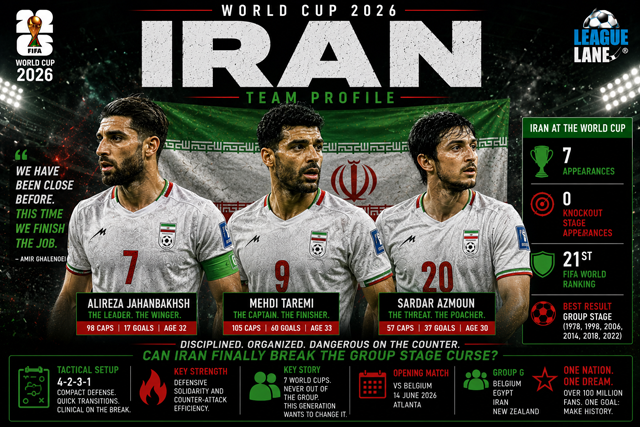
Iran have been to seven World Cups and they have never made it out of the group stage, which is a statistic that follows this team everywhere they go and which has become the defining frustration of Iranian football at the international level.
The closest they came was in Qatar in 2022, when they needed just one goal in their final group game against the United States to go through and they simply could not get it.
Seven tournaments, seven group stage exits, and a country of football fans that is absolutely desperate for a different result this time.
What makes 2026 genuinely interesting is that the group gives them a realistic chance to finally break that cycle. Belgium are a level above in terms of squad quality and probably out of reach, but Egypt and New Zealand are both teams that Iran can match and beat over 90 minutes.
They have a manager with a record that demands respect, a captain in Taremi who has the ability to win games by himself, and a defensive structure that is as well organised as anything else in this group.
Iran are drawn in Group G of the 2026 FIFA World Cup alongside Belgium, Egypt and New Zealand.
“We have been close before. This time we finish the job.” – Amir Ghalenoei
Appearances: 7 | Best finish: Group stage | FIFA ranking: 21st | Never advanced past the group stage
Iranian · Age 62 · Iran manager since 2023 (second spell) · Five Iranian league titles as club manager
Ghalenoei is in his second spell as Iran manager and the numbers he has produced are genuinely impressive. In 42 games in charge he has won 30, drawn six and lost six, which is a better overall record than most international managers in world football right now and which reflects a team that is properly organised and knows exactly how to win matches that matter.
He is a pragmatic coach who never overcomplicated things during his club career and brings the same simplicity to the national team. Iran sit deep, protect their defensive shape, win the ball back through collective pressing and then look to hurt opponents quickly on the counter through Taremi and the wide players before the defence can get set. It is not the kind of football that gets people excited in the neutral stands but it is the kind that wins matches.
Formation: 4-2-3-1
Ghalenoei’s 4-2-3-1 puts collective defensive discipline above everything else, with two holding midfielders protecting the back four and closing down the central spaces that most attacking teams want to play through. When Iran win the ball, the transition is quick and direct, aimed at finding Taremi or the wide players in space before the opposition has the chance to get organised at the back. Every player in this system knows their job and has been doing it together long enough that the whole thing runs almost automatically under pressure.
The absence of Sardar Azmoun, who was left out of the squad following a reported disagreement with the federation, is a real blow to the depth of the attack. He has 57 goals in 91 appearances and is the one player who can genuinely cover for Taremi if the captain is having a quiet game or picks up an injury. Without him, Iran look thin in attack when the plan is not working.
Winger · Dender · Age 32 | Iran caps: 98 | International goals: 17
Jahanbakhsh captains Iran and is one of the most experienced and important wide players in the squad. He was the first Asian player to finish as top scorer in a major European league, with 21 goals for AZ Alkmaar in the 2017-18 season, before spells at Brighton and Feyenoord.
Jahanbakhsh has the knowledge of what it takes to compete at multiple World Cups and consistently performs when the pressure is highest. On the right side of Iran’s attack he provides the width, the direct running and the clever movement off the ball that creates space for Taremi through the middle, and when he picks up the ball in space with defenders to beat, Iran become a genuinely dangerous counter-attacking team.
Forward · Olympiacos · Age 33 | Iran caps: 105 | International goals: 60+
Taremi has scored over 60 goals in over 100 appearances for Iran, a record that makes him the most prolific striker in the history of Iranian football by a significant margin and one of the most underrated centre-forwards in world football over the past decade.
After leaving Inter Milan he joined Olympiacos and continued to score with the kind of consistency that only genuinely world-class strikers sustain across multiple leagues and countries.
At 33 this is almost certainly his last World Cup and the determination that comes from that reality will make him a very dangerous opponent for every goalkeeper in this group. He holds the ball up well, scores with both feet, and brings the players around him into the game in ways that go beyond his goal tally alone.
Goalkeeper · Tractor · Age 33 | Vice-captain
Beiranvand is one of the most popular goalkeepers in Asia and a genuinely commanding presence between the posts for Iran across several international cycles. His shot-stopping ability and dominance in the air have given Iran a solid and reliable defensive platform throughout the Ghalenoei era, and the experience of multiple qualifying campaigns and tournament football means nothing that happens in Group G will be unfamiliar to him.
In a team designed to keep things tight and win on the smallest of margins, having a goalkeeper of his quality and mental strength behind the defence is absolutely essential to how the system works.
Midfielder · Shabab Al-Ahli · Age 29
Ezatolahi is the midfield anchor around whom Ghalenoei’s entire system is organised and his contribution to this Iran team is the kind that only gets noticed when he is not there. He wins the ball, breaks up play before it becomes dangerous and gives the players in front of him the clean, simple platform they need to do their jobs without constantly looking over their shoulder.
He is not a player who attracts attention from European clubs, but he is the kind of player every intelligent coach wants at the base of their midfield. His role in this Iran team is similar to what Amrabat did for Morocco in 2022.
Iran are too experienced to be rolled over by New Zealand in the opener, and the Egypt game on June 27 is genuinely difficult to call because both teams are built around a single world-class forward. Whoever has the better game between Taremi and Salah will likely decide who goes through in second place.
The betting angle is Iran to beat New Zealand in the opening fixture. Ghalenoei has won 30 of 42 games in charge, Taremi is one of the most clinical strikers in Asian football history, and New Zealand, for all their spirit and organisation, are facing a level of opposition they simply do not encounter in OFC qualifying. At the right odds, Iran to win that game is a confident selection.
Iran’s ceiling at this tournament is the round of 16 and they have a genuine path to get there. The Egypt match on June 27 will decide everything. If Taremi fires and Ghalenoei’s defensive structure holds, Iran can finally end their group stage cycle.
You can find all our World Cup 2026 match predictions and analysis on LeagueLane.