Back
Back
Aron Wright - January 6, 2026
The global football ecosystem will enter a watershed year in 2026, which will provide the shrewd investor with a special combination of challenges and opportunities. As the FIFA World Cup has increased to 48 teams and is hosted by the tri-nation block of Canada, Mexico, and the United States, the conventional football calendar is being disrupted at an unparalleled level. To individuals who are involved in sports betting, this is not just a summer of fun; it is a season of more event risk that will essentially reorganize the domestic leagues, reshape the player fatigue curves, and establish unique periods of market inefficiency.
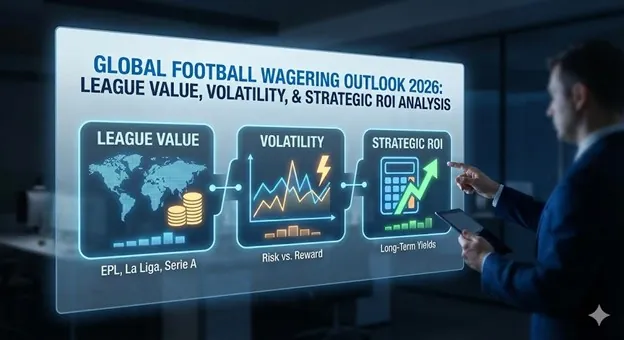
This is an in-depth view of the logistical and statistical future of 2026. We find the best investment vehicles to use in the next cycle once we get past the entertainment aspect and concentrate on mathematical suitability, liquidity, and volatility. Whether it is the safe havens of high liquidity of the Premier League or the high-goal and unpredictable Bundesliga, or the structural peculiarities of the Major League Soccer (MLS), this guide shows where value is in a year of change.
The extent of the disruptive impact of the expanded tournament should be quantified to effectively navigate the markets in 2026. In contrast to the old system, which consisted of 32 teams, the new system is 48 teams wide, which expands the number of players who had international commitments, essentially. This growth trickles down to other groups of club teams, such as second-tier leagues, like the English Championship and the Spanish Segunda Division, who might once have been insulated against international disruptions.
The logistical needs of a mid-year tournament in North America would demand the extreme condensing of the 2025/2026 European season. Competitions like the Premier League and La Liga have to end their action at the end of May, which forces them to have a more crowded schedule during the winter and spring before it. This traffic causes managers to dive deeper into squad rotation and creates more variance for the bettor.
A “First XI” which warrants a strong favorite price in October 2025 might already be unidentifiable by April 2026 as required load management takes place. This further increases the gap between elite clubs that can afford two possible starting lineups of players, e.g, Manchester City or Real Madrid, and mid-table clubs with smaller squads. In the context of sports betting strategies, this generates certain value in betting against fatigued mid-tier teams in the later part of the year, where the market might fail to sufficiently explain that difference in depth.
Studies conducted on the performance of players after major international tournaments show that there is a measurable decrease in physical performance, that is, sprint distances and high-intensity runs. This is what is commonly referred to as the World Cup Hangover, and it provides the betting industry with a golden opportunity to bet on the beginning of the 2026/27 season in August and September.
Here, market inefficiencies usually occur due to the fact that historical reputation dominates the opening lines. However, teams that contributed heavily to the deep stages of the World Cup are statistically more likely to underperform against their Expected Goals (xG) metrics in the first month of the new season. On the other hand, clubs with fewer internationals have a very serious, non-stop pre-season, which in many cases causes upsets at the beginning of the season. This dynamism renders the post-tournament window a golden time of supporting prepared underdogs or laying heavy favorites who are physically weak.
Verdict: Best League for Goal-Based Markets (Over/Under, BTTS)
The entire volume is largely absorbed by the Big 5 European leagues (Premier League, Bundesliga, La Liga, Serie A, and Ligue 1). Although high liquidity enables professional gambling investors to make large bets without influencing the odds, not all liquidity is equal to value.
The Bundesliga is always going against the trend of tightening the defenses in the rest of Europe. The 2024/25 cycle data is the most prolific of the best leagues with an average of 3.13 Goals Per Game (GPG). The league strategy is based on the philosophy of Gegenpressing (counter-pressing) and high defensive lines, which results in the establishment of a transition-heavy game state in which turnover of possession may result in a subsequent high-quality scoring opportunity.
To the sports betting fan, it is this scoring ability that makes the Bundesliga the most suitable means of Over strategies. Typical markets covering Over 2.5 Goals are frequently flooded, but since 4+ game events are frequent, the Over 3.5 or the Asian Total 3.0 lines are very appealing. More than that, the all-in tactical strategy implies that even strong teams such as Bayern Munich can be vulnerable to conceding against the break, and the percentages of the Both Teams To Score (BTTS) structure are structurally bigger than in La Liga or Serie A.
Verdict: Best League for High-Stakes Handicap Betting
The Premier League is the most established market in the world, as it has an average of 2.93 GPG in the 2024/25 season. Its main asset is liquidity, and hence it is the haven of high volume investors. The league is characterized by a division between the elite and the rest, where the elite teams are characterized by extreme home superiority.
This consistency renders EPL the most suitable place to bet on favorites through Asian Handicap betting. When the top-tier group is hosting an encounter with a bottom-six group, the market frequently arranges the bet at -1.75 or -2.0. The statistical evidence is that the wealth gap enables these elite teams to pay huge spreads more or less regularly. Nevertheless, since the EPL closing line is so sharp, it takes time to beat the market. Early market entry – betting that lines will open weeks earlier – will enable bettors to gain value before sharp money replenishes the price. Monitoring team news in 2026 will be of critical importance because of the fatigue associated with the World Cup; the aggressive line movements will operate based on the availability of the players.
Verdict: Best League for “Unders” and “Win to Nil”
La Liga is a sharp departure from the anarchy of the Bundesliga. It is the lowest scoring of all the major leagues with an average of 2.62 GPG. Besides the conventional giants, the Spanish teams focus on tactical form and low defensive blocks, which leads to a high percentage of low-scoring draws and close victories.
Plans in this area should rest on Win to Nil markets. Such teams as Atletico Madrid have historically been able to dominate games without being prolific scorers. Betting on a Home Win to Nil has much greater statistical odds than a basic match result bet and is in line with the statistical data of the league. Although odds are weighted to suit the lower scoring, the structural deficiency of verticality relative to Germany makes the systemic lack of verticality of the Under 2.5 bet seldom at risk in match-ups between mid-table teams.
Although the Big 5 are safe, tier 2 leagues can be more profitable due to the smaller investment that a bookmaker makes in modelling such leagues. Inefficiency prevails more in this area, providing intelligent punters with a unique advantage.
The Eredivisie can be considered even better than the Bundesliga by the goal-oriented people. With an average of approximately 3.01 GPG, the league can be characterised by an enormous chasm between the three leading participants (PSV, Feyenoord, Ajax) and the remainder of the participants. These professional teams have offensive weapons that simply cannot be held back by the defenses of the lower tiers, and this often results in blowout scores.
It is a simple betting strategy in that the difference is such that Asian Handicaps of -2.0 and -2.5 on the best teams can be considered a play. In addition, the defensive frailty of the bottom half makes the betting proposition of Over 3.5 Goals a statistically valid bet in games with the top five and usually a more profitable bet than the Over 2.5 lines, which are so heavily juiced in the big markets.
The English Championship is a 46-game attrition war with an average of 2.45 GPG. In comparison with the Eredivisie, the distance between 1st and 24th is lower in this major league than in any other major league. This equality causes an increase in the number of draws and low-scoring matches.
This atmosphere is best suited to draw hunting and under 2.5 Goals. Sponsoring the draw matches of the mid-table teams can be very profitable because the market often overestimates the chances of success of the favorite. Also, the Asian Handicap +0.5 (Double Chance) of the away underdogs also works well here since the home advantage is not that decisive as in the Premier League.
Verdict: Best League for Volatility and Specialist Bettors
MLS in 2026 is a unique asset class. Being the main league of the host region, MLS will introduce an unprecedented regular-season hiatus between the end of May and the middle of July. This seven-week break is a successful disruption of the season into two mini-seasons, and it kills their continuity and form.
To the sports betting expert, such a disruption necessitates a reset of all power rankings in July that will provide a competitive advantage over algorithms that could be slow to adapt. Also, the existence of the global superstars leaves a black hole of liquidity in the population. Teams such as Inter Miami are frequently the beneficiaries of blind public money, and their moneyline odds are forced to unsupportable lows. The worth is often in the fact that it decays this popular zeal, namely by supporting home underdogs in the handicap line to take advantage of the substantial travelling exhaustion of cross-country MLS matches.
The cost of participation must also be considered in order to find the best league. The commission paid by the bookmaker is known as the margin (or overround), and this cost is essential to reduce to succeed in the long-run.
Statistics of large operators across the world depict a specific order. The EPL and similar Tier 1 leagues usually have match-winner margins in the range of 2.0% -3.5%, whereas Tier 2 leagues such as the MLS or the Eredivisie can have margins in the range of 5.0%-7.0%. Nonetheless, one of the major findings that would be critical in 2026 is the dominance of the Asian Handicap markets, which are always cheaper compared to European 1X2 markets. An Asian Handicap line in the Premier League could therefore have a vig of 2 percent, whereas a normal win bet will have 3.5 percent.
In 2026, strategic investors will be advised to move to Asian markets at least in Asian Handicap markets, wherever possible. This minimizes the tax that is paid on each bet, which effectively enhances ROI without altering the accuracy of prediction.
From a combination of the calendar peculiarities and the statistical characteristics of such leagues, there are three different frames of the year to come.
Target: German Bundesliga (Aug 2025 -May 2026) Thesis: The systemic nature of the tactical direction of the league provides a floor to the goal scoring, which the bookmakers should not be capable of pricing correctly without giving excessive value to the Under. Mechanism: Match-filtering betting to exclude the bottom three teams and bet the Over 3.0 Asian Goal Line. The push protection on three goals precisely is worth something in a league with an average of 3.13 GPG, and it is a refund on a common 3-1 or 2-2 finish and a reward on the common 3-1 or 2-2 thrillers.
Target: FIFA World Cup Group Stage (June – July 2026) Thesis: The quality is watered down by the increase to 48 teams. Elite seeds will be pitted against much weaker countries in enlarged qualification routes than in the past. Mechanism: Back top seeds Asian Handicaps (-1.5 / -2.0) in Matchdays 1 and 2. The goal difference will make a major tiebreaker, and the high-end teams will seek to score heavily against weak competition. The bettors, however, are advised to shift to Unders in the Knockout Stage since the fear of loss sets in, and game conditions become tight.
Target: Premier League & La Liga (Aug 2026 -Oct 2026) Thesis: Physical and mental exhaustion during the World Cup will result in the under-performance of the leading teams during the early World Cup season 2026/27. Mechanism: Find clubs that have the most minutes in the World Cup Semifinals/Finals and lay/bet (bet against) such clubs during their 3 initial away games. They are susceptible to home underdogs who are high-energy and have had a full summer of rest.
The best betting portfolio to use in 2026 can not be monolithic. It must have a strategy of allocation that is stable, growing, and high-yield alpha.
The shocks of 2026 are no longer threats; instead, they are a prospect of calculated opportunity by seeing sports betting as an investment in information and logistics as opposed to a gambling game.