Back
Back
Aron Wright - January 6, 2026
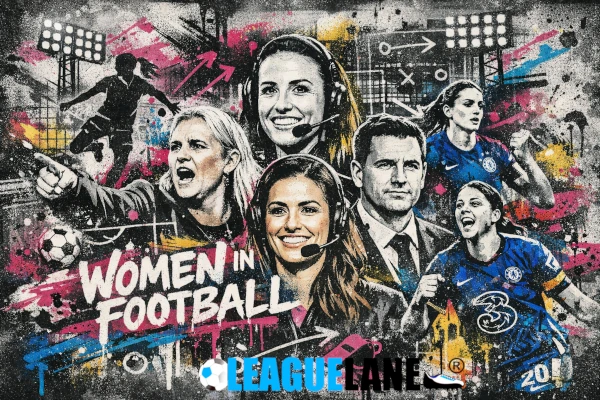
Modern football is built on systems. Who designs them, who controls them, and who holds them together under pressure now matters more than who shouts the loudest. In that reality, women are not reshaping the game from the margins. They are already governing its centre.
In this landscape, women are central to how modern football is governed, played, and commercialised. The following figures reflect that shift, shaping the sport through data-led decisions, elite performance, and institutional authority.
If early investment represented the entry of finance into football, Michele Kang represents its evolution into the multi-club ownership model. As the owner controlling the Washington Spirit, Olympique Lyonnais Féminin, and London City Lionesses, Kang drives the first true global conglomerate dedicated to women’s football.
Her influence is structural; she has decoupled her teams from men’s operational shadows, pouring capital into independent science and infrastructure to prove women’s football is a standalone asset class, not a CSR initiative.
As the first female Chair in the Football Association’s 157-year history, Debbie Hewitt operates at the structural core of the English game. Her influence lies in governance reform and investment oversight.
Under her leadership, resource allocation has become transparent and outcome-focused, stabilizing the link between administrative governance and pitch-side results across both elite and grassroots levels.
As UEFA’s Managing Director of Women’s Football, Nadine Kessler is the continental architect. She designed the structural overhaul of the Women’s Champions League and the expansion of the European Championships.
Her power is decisive: she dictates the calendar, prize money, and licensing criteria that force clubs to professionalise. While players control the pitch, Kessler controls the platform.
The President of the Norwegian Football Federation is the primary disruptor in global football politics. Lisa Klaveness leverages her position to challenge FIFA on human rights, bidding transparency, and competitive balance.
In a room of consensus, she is the dissenting voice, forcing major bodies to account for the ethical cost of their expansion strategies.
Amanda Staveley’s impact reflects the modern intersection of finance and sporting ambition. Her influence is defined not by symbolic ownership, but by strategic involvement in long-term planning and infrastructure.
She established a blueprint for how financial strategy shapes squad building and recruitment cycles, setting a standard for sustainability and decision discipline in club takeovers.
Wiegman’s influence is rooted in repeatable success. Her work with the Netherlands and England has redefined how international teams manage game states and tournament pressure.
England’s consistency under her leadership reflects a clear tactical structure – disciplined pressing and efficient possession, rather than emotional momentum.
Sarina Wiegman has raised expectations across the game, influencing coaching education well beyond international football.
Now leading the USWNT after a dynasty at Chelsea, Emma Hayes controls the most commercially visible entity in women’s sport.
Her influence lies in cultural translation; she bridges the gap between European tactical sophistication and American athleticism.
When Hayes speaks on player welfare or fixture congestion, the industry listens because she sets the tactical meta for the global game.
Alexia Putellas represents influence through authority. Her role at Barcelona and Spain demonstrates how midfield control dictates outcomes. She drives tempo, controls central zones, and links structure with creativity.
Her influence goes beyond stats; Barcelona’s ability to limit opposition transitions is tied to her positional intelligence, making her the reference point for how elite midfielders manage games.
Sam Kerr’s influence is grounded in efficiency rather than volume. Her scoring record is a product of elite movement, anticipation, and game state awareness.
She thrives in high-pressure moments where shot selection matters most. Her profile aligns with modern analysis, where conversion rates and positional intelligence outweigh raw chance counts.
Steinhaus-Webb remains influential through refereeing standards. Her Bundesliga experience established credibility at the highest level, and her current roles focus on professionalizing how referees are trained.
In an era where officiating is scrutinised through data, her influence lies in creating consistency and decision-making frameworks for the next generation of officials.
Jill Scott is the primary bridge between the men’s and women’s game in mainstream media. A fixture on platforms like The Overlap, she validates the tactical intellect of female players to legacy audiences.
Beyond media, her coaching work at Manchester City’s academy addresses the pipeline problem, ensuring the next generation sees women holding the tactics board, not just wearing the kit.
Jill Scott represents influence through cultural reach and accessibility. Her impact is not tactical or institutional in the traditional sense, but she has played a major role in how women’s football is understood, consumed, and normalised by a wider audience.