Back
Back
Arun - July 1, 2025
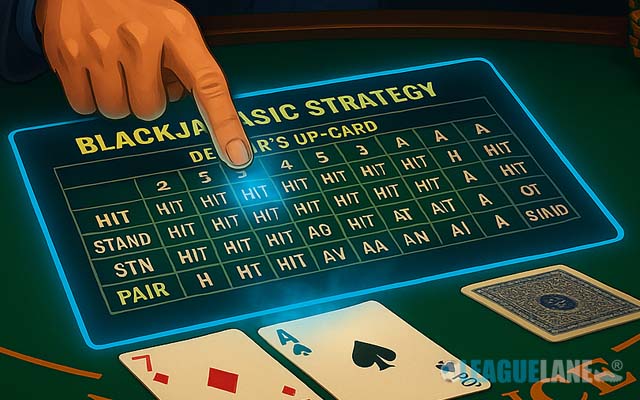
Blackjack is one of those rare games that balances simplicity with deep strategy. Whether you’re sitting at a smoky table in a Vegas casino or tapping away on your phone at home, knowing when to hit or stand in blackjack can mean the difference between a win and a bust. Most players lean on a blackjack basic strategy chart to guide their decisions, but some hands—like the infamous 12 vs. 3 blackjack situation—still manage to stir doubt even in seasoned players.
You’re dealt a hard 12—a seven and a five. The dealer shows a 3. Instinct might tell you to stand and hope the dealer busts. After all, 12 is already a fragile total, and no one wants to be the person who hits and busts on a hand that “felt” winnable.
But here’s where blackjack’s counterintuitive logic kicks in.
According to blackjack strategies that actually work, the correct move here is to hit. Yes, really. Even though you’re flirting with the risk of busting, the math is on your side—so long as you follow the strategy exactly and take only one card. The logic here is subtle, but powerful: it’s not always about winning more often, but about losing less over time.
This is why seasoned players don’t deviate from the numbers, especially in edge cases like this.
Let’s do a quick dive into the probabilities.
You’re facing a 12, and there are 10 cards that won’t bust you if you hit—anything from an Ace to a 9. Only the 10-value cards (10, J, Q, K) will send you over 21. That gives you about a 71% chance of survival when you hit.
Because if you stand, you’re statistically going to lose more in the long run. Here’s how it breaks down:
That loss percentage outweighs the extra wins you’d squeeze out by standing. It’s a classic example of minimizing loss, not maximizing wins.
That 5% push rate may not seem exciting, but in blackjack, a push is a win compared to losing. Your original bet is returned, and you get to try again without penalty.
This is where a blackjack basic strategy chart shines—it’s built on cold, hard numbers, not emotion. And if you’re serious about long-term gains or minimizing the house edge, it’s your best friend.
Understanding blackjack dealer bust probabilities gives you an extra edge. When the dealer shows a 3, their overall bust rate is about 37%. It’s not the worst card they can show—that title belongs to the 5 and 6—but it’s still a “stiff” upcard, meaning the dealer is at a higher risk of busting.
Compare that to a dealer showing a 2 (bust rate of around 35%) or a 6 (closer to 42%), and you’ll understand why decisions like hitting on a 12 require precision. You can’t always rely on the dealer to fail—you’ve got to make your hand as strong (or as safe) as the odds allow.
Many new players learn when to hit or stand in blackjack using printed charts or apps—and that’s a great start. Generally, the rule is:
But charts won’t cover everything. Blackjack is dynamic. Sometimes your gut might pull you in a different direction—and sometimes, that’s okay. The game isn’t just numbers; it’s rhythm, pattern recognition, and yes, sometimes taking a calculated risk.
Still, don’t let your gut override the data when the stakes are high. Blackjack strategies that actually work are built from millions of simulated hands and decades of research. Trust them before you trust your “feeling.”
The 12 vs. 3 situation is a perfect example of how blackjack plays tricks on our instincts. Standing feels safer, but mathematically, it’s a trap. Hit once, minimize your losses, and live to fight another hand. That’s the thinking behind smart blackjack play.
So whether you’re playing casually or grinding for the long haul, remember: blackjack rewards discipline, not hunches. Stick to strategy, learn the odds, and know when to trust the numbers.
And next time you’re staring down a 12 against a 3? You’ll know exactly what to do.