Back
Back
Afolabi Ezekiel - July 1, 2025
In what will be remembered as one of the most dramatic nights in Club World Cup history, Saudi Arabian giants Al Hilal shocked European champions Manchester City with a 4-3 extra-time win in the round of 16, a result that reverberated across global football.
The victory not only marked a milestone moment for Al Hilal but also proved Saudi Arabia’s growing impact on the global football landscape, a movement fueled by the country’s Public Investment Fund (PIF), which took control of four major clubs in the Saudi Pro League in 2023.
As hosts of the 2034 FIFA World Cup, Saudi Arabia has intensified its sporting ambitions. PIF’s reported $1 billion investment in streaming platform DAZN, which also acquired Club World Cup rights from FIFA for the same sum, is part of a larger strategy to build prestige through high-profile football ventures.
Led by Simone Inzaghi, Al Hilal secured $13.7 million from the tournament prize pot and will now face Brazil’s Fluminense in the quarterfinals on Friday at the Camping World Stadium in Orlando.
The contest was pure chaos, a fitting tribute to the Champions League-style drama often associated with Inzaghi’s Inter Milan tenure. It featured everything from disputed goals to last gasp defending and extra-time heroics.
City’s opener came with drama. Bernardo Silva tapped in after the ball struck Rayan Ait-Nouri’s arm and then Ilkay Gundogan’s upper limb. While both incidents appeared unintentional, Al Hilal were outraged and initially refused to restart play, forcing referee Jesus Valenzuela to publicly confirm the decision over the stadium PA system.
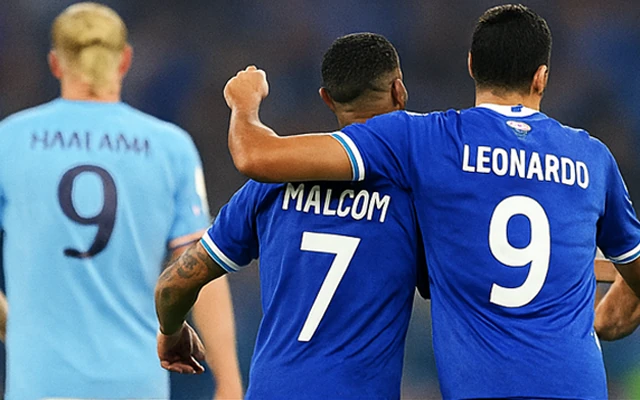
From there, the match went into overdrive. Marcos Leonardo equalized less than a minute into the second half after a dazzling run by Malcom, who would then put Al Hilal ahead 2-1 with a blistering breakaway goal in the 52nd minute, courtesy of Joao Cancelo’s pinpoint pass.
Erling Haaland responded swiftly for City, but Al Hilal were awarded a penalty moments later, only for it to be overturned due to offside. Mohamed Kanno missed a late chance to win it, while Ali Lajami made a miraculous goal-line clearance of Haaland’s 84th-minute header, sending the match into extra time.
Guardiola was visibly furious when the referee ended regulation time while Jeremy Doku was launching a dangerous run. But things got worse when Kalidou Koulibaly headed home a Ruben Neves corner to put Al Hilal 3-2 up in extra time.
Phil Foden, however, responded with a magnificent volley to level the score again at 3-3. But it was Leonardo who sealed the win, bundling the ball home in the 112th minute after Ederson had denied Sergej Milinkovic-Savic.
From a financial standpoint, City’s early exit means a loss of $13.7 million in potential earnings. Instead, they walk away with roughly $51.7 million from the competition. On the pitch, it’s a sobering reminder that dominance in Europe doesn’t always translate globally, especially in a tournament with razor-thin margins and rising competition.
Despite impressive performances against Juventus and a strong first half versus Al Hilal, City faltered. The upside? With the Premier League still six weeks away, Guardiola’s men now have time to regroup and prepare, though it wasn’t the ending they envisioned.
While City weren’t at full throttle, Al Hilal’s composed, and clinical approach deserves immense credit. Their progression to the quarterfinals alongside two Brazilian clubs, gives the Club World Cup added legitimacy.
The Saudis remain unbeaten on U.S. soil this summer and have emerged as one of the standout sides of the tournament. The thrilling match, combined with Fluminense’s victory over Inter, gave the Club World Cup a rare day of genuine excitement, away from concerns about empty seats or weather delays.
City knew what Ruben Neves and Kalidou Koulibaly were capable of. Neves, formerly of Wolves, delivered a lethal set piece for Koulibaly to nod home in extra time.
Both stars joined Al Hilal during the 2023 transfer window, lured not only by lucrative contracts but also by the ambitious football project in Saudi Arabia. Their quality was undeniable and evident throughout, especially Neves, who thrived in a central defensive midfield role in Inzaghi’s back five.
Al Hilal’s refusal to kick off after City’s first goal was rooted in their anger over the apparent handballs in the buildup. Though VAR didn’t instruct a monitor review, players were livid while goalkeeper Bono even marched to midfield during the four-minute delay.
Ultimately, Valenzuela reiterated his decision via the stadium PA and ordered play to continue, though tensions lingered well into the first half’s cooling break.
Phil Foden, who returned to action after a personal break last season, proved his class with a stunning volley from a tight angle, one of his three goals at the tournament. His 100th strike for City showcased his finesse and reaffirmed his importance ahead of the new season, even if it came in a losing effort.
Malcom was simply electric. His 60-minute shift included an assist and a goal, both showcasing his speed and incisiveness. The Brazilian tormented City’s defense and might have stayed on longer if not for a hard challenge by Ruben Dias. Once written off after a quiet spell at Barcelona, Malcom has rebuilt his reputation, first at Zenit, now on the world stage with Al Hilal.
Yassine ‘Bono’ Bounou reminded everyone of his World Cup heroics with Morocco, producing yet another standout performance. From reflex saves to denying one-on-one chances, Bono was a fortress in goal.
So far in the tournament, he’s prevented three goals beyond expectation, including a penalty stop against Real Madrid. While Al Hilal boasts attacking flair and marquee names, Bono remains one of their most essential assets.
What’s Next?
Al Hilal’s journey continues Friday, July 4, when they take on Fluminense in Atlanta at 3 p.m. ET / 8 p.m. UK time. Another victory could elevate their campaign from historic to legendary.