Back
Back
Afolabi Ezekiel - December 12, 2025
Cameroon should be calmly counting down to the start of the 2025 Africa Cup of Nations (AFCON) in Morocco. Instead, the country is watching a public institutional battle spill into the most sensitive area of national team football: player selection.
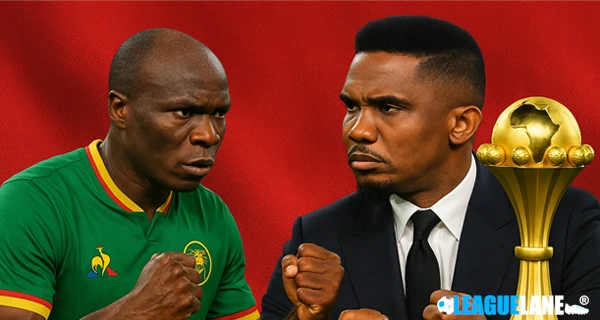
In the space of a few days, Cameroon’s football leadership moved to remove the head coach, publish a squad that excludes some of the biggest names in the dressing room, and hand control to an interim replacement. The coach at the center of the dispute has pushed back, insisting the process is not as settled as the federation claims. What has emerged is no longer a story purely about football decisions, but one about authority, legitimacy, and who truly runs the national team.
The roots of the current crisis stretch back to early April 2024, when the sports ministry appointed Belgian coach Marc Brys without the involvement of the Cameroon Football Federation (FECAFOOT), led by Samuel Eto’o. Reuters reported that the federation argued it had not been consulted and viewed the appointment as a breach of the established framework for national team management. Sports minister Narcisse Mouelle Kombi, however, defended the decision as lawful.
The disagreement quickly escalated beyond bureaucratic tension. By May 2024, media outlets were already describing the situation as a crisis, with reports of tense exchanges and open hostility surrounding the first meetings between Eto’o and Brys.
The dispute also carried wider implications. Global football’s governing body has strict rules against government interference in federation affairs, and Reuters noted that such conflicts can lead to sanctions if judged to cross that line.
The power struggle soon acquired a legal dimension. In May 2024, Reuters reported that Marc Brys’ appointment was suspended by the country’s top sports tribunal following a petition from an amateur club, adding further uncertainty over who held final authority.
This matters in the current squad controversy because it established a precedent: decisions regarding the national team were already being challenged through institutions outside the normal football hierarchy. Cameroon’s technical direction stopped looking like a clear chain of command and began to resemble a tug of war.
Fast forward to the first week of December 2025, and the conflict returned with full force. Reuters reported that the federation removed Marc Brys as head coach, installed David Pagou as his replacement, and simultaneously announced Cameroon’s AFCON squad. That squad announcement became the spark that ignited outrage.
According to reports, goalkeeper André Onana and veteran striker Vincent Aboubakar were omitted, alongside several other experienced players, in a selection framed as part of a broader reset following Cameroon’s failure to qualify for the 2026 FIFA World Cup. The timing intensified the backlash. AFCON runs from December 21, 2025, to January 18, 2026, leaving Cameroon little time to resolve internal turmoil before the tournament begins.
Leaving out Onana and Aboubakar is not merely a tactical debate for Cameroonian supporters—it cuts to identity.
Onana is one of the country’s highest-profile players in Europe, and goalkeepers often serve as vocal leaders within national teams. Aboubakar, meanwhile, has been a long-serving figure and captain in recent cycles. Dropping both simultaneously feels, to many fans, like a political statement as much as a footballing one. Reuters framed the omissions as part of a move away from several experienced players.
Even if renewal is the federation’s objective, attempting it on the eve of a major tournament invites suspicion. Supporters tend to accept generational change when it appears planned. They revolt when it resembles a sudden purge.
At the heart of the controversy lies a central question: who actually picked the squad—the coach or the federation president?
One of the most explosive elements of the story is the allegation that the squad list was effectively decided above the coach’s head.
Multiple outlets have carried claims attributed to Marc Brys that Samuel Eto’o influenced, or even directly shaped, the selection. One report summarized Brys’ position as arguing that key leaders were excluded for reasons unrelated to football.
Even without treating these claims as established fact, their existence explains why this has escalated into a scandal rather than a routine selection debate. A national team list is meant to be the coach’s responsibility. When supporters believe it is being drafted in a boardroom, it stops being a list and becomes evidence in a power struggle.
Normally, once a federation sacks a coach, appoints a replacement, and publishes a squad, the matter is settled. In Cameroon’s case, that assumption does not hold.
Earlier in the year, Brys publicly denied reports that he had resigned, with Reuters describing the episode as another twist in the ongoing dispute. That history fuels today’s uncertainty and raises practical concerns: who communicates with the players, who runs camp, and whose tactical and disciplinary rules apply?
Even the perception of competing centers of power can undermine preparation. Players begin focusing on politics, media narratives, and loyalty rather than chemistry, rhythm, and match plans.
Alongside documented governance issues, social media and some tabloids have promoted a more sensational claim: that Aboubakar was excluded to prevent him from closing in on Eto’o’s national team scoring record.
This allegation is widely circulated but not supported by reliable reporting and should be treated with caution. Its significance lies less in its truth than in what it reveals—once trust collapses, every football decision becomes a motive story, regardless of evidence.
Cameroon’s group is unforgiving. Ivory Coast, the defending champions, headline the group, which also includes Gabon and Mozambique. Every day spent battling governance issues is a day lost in preparing a coherent tactical plan.
There are also administrative risks. When a national team is caught between a government ministry and its federation, it attracts scrutiny from international football authorities. Reuters has previously noted that this dispute carries a theoretical risk of sanctions if political interference is confirmed.
At the center of the scandal are three hard facts and one unresolved question. The facts, as reported by multiple outlets, are that the federation removed Marc Brys, appointed David Pagou, and released a squad that omits André Onana and Vincent Aboubakar. The unresolved question is legitimacy: in the eyes of players, supporters, and global football authorities, who has the right to make the final call?
Until Cameroon answers that question clearly, every squad decision will continue to be read as political—and every football choice will carry the weight of a national dispute.